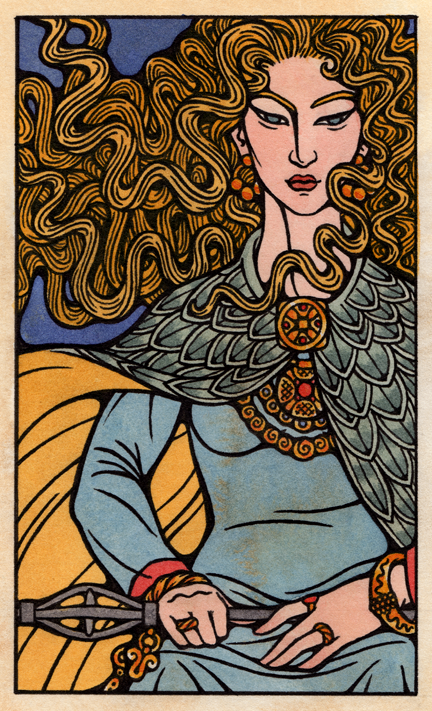

Freyja is the Norse Goddess of the Earth, Fertility, and Beauty, who is
the daughter of the Earth-goddess Nerthus and Njordr, God of Wealth. Her name
means "the Lady" and She and Her brother Freyr ("the Lord")
are the chief Gods of the Vanir. Her two daughters by the God Od are Gersimi
("Ornament") and Hnossi (Treasure").
The Norse Gods are usually divided into two "clans": the Vanir,
Gods of the Earth and Fertility, and the Aesir, Gods of the Sky and Intellect.
In the myth, these two tribes warred for a long time before peace was made,
with the Aesir having the final advantage. This may be a mythologizing or
folk memory of an invading (sky-god worshipping) Indo-European people grafting
their religion onto an indigenous earth-centered one.
Freyja is accounted very beautiful and sexual. She was originally said to
have been married to the traveller God Od, who vanished. She wept and wept
for his loss: where Her tears fell on the land, they became amber; where they
fell in the Sea they became gold, and both are sacred to Her.
Her most well-known possession is the wondrous necklace Brisingamen, ("Fire
Jewelry"), made by the four Dwarf brothers Dvalin, Alfrik, Berling, and
Grer. When She saw the gorgeous golden necklace She absolutely had to have
it, and offered the brothers much gold and silver and jewels. But being Dwarves
they could easily come by that, and anyway, the only thing they really wanted
from Her was that She spend a night with each one of them. She readily agreed,
and got Her necklace.
In another tale the Giant Thrym stole Thor's Hammer Mjollnir, and as the
price of its return demanded Freyja as wife. Loki,
who was brokering the deal, agreed to his terms, but Freyja was extremely
angry at being sold like this and refused. So Thor borrowed Brisingamen and,
dressed as Freyja in a lovely dress and long veil, went to the Giant (who
must have been both very stupid and very near-sighted). Thor played along
long enough to get His hammer back and kill Thrym with it.
Freyja is said to also possess a marvelous coat of feathers that transforms
the wearer into a falcon and enables Her or Him to fly. Loki is forever borrowing
it, which has led to some speculation that Loki is a little gender-confused
since symbolically it is cross-dressing.
She has Her death-aspect as well, and is considered the leader of the Valkyries,
the swan-maidens who choose who is to be slain in battle. She has a great
hall called Folkvang, where half the warriors go after death, the other half
going to Valhalla.
Freyja is often confused with Frigg or Frija, the Aesir wife of Odin, and
in some tales Freyja is also called Odin's wife. The two names however are
not related and stem from different roots, although they certainly look very
similar, especially when you figure in the variants. Freyja, as I said above,
is from a root meaning "Lady", which is seen in the archaic English
word for "woman", frow, as well as the German Frau,
the equivalant of our "Mrs." Frigg or Frija means "beloved"
or "wife" and comes from a root that gives us "free" and
"friend". Freyja's early husband Od has also been equated with Odin.
But don't feel too bad if you mix them up--even the ancients confused them,
though the Icelandic texts are careful to distinguish between the two.
My guess is that Frejya represents the chief Goddess of a pre-Indo-European
culture (with Her brother Freyr the chief God) that was in conflict with and
then learned to co-exist with the Sky-worshipping Indo-European mythology.
Which would account for why She is sometimes considered Odin's wife (just
like the patriarchal Zeus had many "wives" besides Hera
who represented the earlier local Goddesses), and why Her nature and Frigg's
are different--while Freyja is sexually independent of a man, Frigg is the
model of married womanhood and the domestic life.
This card in a reading indicates great beauty and unorthodox methods. Others
may be quick to judge, but the only person living with your moral decisions
is you yourself.
Variant spellings: Freyja (Icelandic), Freyia, Freya, Freia, Frua, Frowa.
Also called: the Frowe ("the Lady"), Vanadis (as leader of the
Disir, or ancestral female spirits, which include the Valkyries), Mardoll
or Mardal, as the sun shining off the water.
And just for kicks, here are the versions of the name of Odin's wife Frigg:
Frigg (Icelandic), Frig (Anglo-Saxon), Fria or Frija or Friia (Old High German),
Fricka, Fri, Frea. Friday (Anglo-Saxon Frigedaeg) is named for Her,
through an equation with Venus whose day it was, though to me Freyja would
seem a better choice.
To read Her tale, go here.
