
Goddess Oracle Deck

Aida-Wedo
Al-Uzza
Amaterasu
Anat
Aphrodite
Ariadne
Arianrhod
Artemis
Athene
Benzaiten
The Black Virgin
Blodeuwedd
Bride
The Cailleach
Ceres
Cerridwen
Ch'ang O
Chalchiuhtlicue
Coyolxauhqui
Danu
Diana
Erzulie
Faerie
Fatima

Freyja
Gaea
Ganga
Green Tara
Gwenhwyfer
Hathor
Hekate

Hel
Hera
Ho Hsien-Ku
Idun
Inanna
Ishtar
Isis
Jeanne D'Arc
Kali
Kamrusepas
Kelaeno
Kirke
Kore
Kwan Yin
Laverna
Lilith
Macha
The Magdalene
Maman Brijit
Medusa
Melaina

Momoy
Morgana
Nekhbet
Nu Kua
Nut
Nyx
Oshun
Oya
Pele
Pomona
Rhiannon
Sedna
Sekhmet
Selene
Sengen
Sheila-na-gig
Sibyl

Sif
Skuld
Sophia
Sri Lakshmi
Sunna
Tlazolteotl
Uma
Vesta
The Virgin Mary
Vivian
White Tara
Yemaya


Get updates on new art and products when you sign up for the
A-Muse-ing Grace Gallery Newsletter!


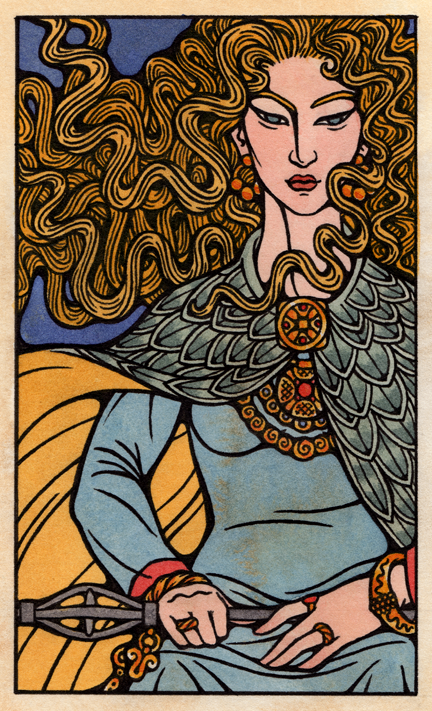
Sedna is the Inuit (or "Eskimo", though the word is an insult) Goddess of the animals of the Sea, who is considered malevolent to humans, and greatly feared. Offerings are made to Her in an effort to win Her over and ensure plentiful hunting. The word Inuit is often translated simply as "the People"; however the singular form, inua, is the word for "soul" or "spirit", giving it a far richer meaning.

Sedna's legend is quite sad:

She was the beautiful daughter of a widower and had many suitors, all of whom She refused. Then a handsome hunter came and succeeded in winning Her over, and took Her away to his Land of Birds--for he was actually a Kokksaut or petrel-spirit in disguise as a man. When Sedna found out his true nature, She was inconsolable that Her husband was not what he had seemed.

In the meantime, Sedna's father, missing Her, made his way to Her new home, and finding Her husband away took his weeping daughter back. Together they set out to their home back across the Sea. But the petrel-husband followed them demanding his wife back. The father refused, and the Kokksaut changed into his bird-form, summoning a great storm. In horror and blind panic at having offended the bird-spirit, Sedna's father came to the conclusion that to save himself he must give Sedna as a sacrifice. So he threw his own daughter into the raging Sea. In desperation She grabbed the side of the kayak, but he took an axe and cut Her fingers off to the first knuckles. She clutched the kayak a second and third time, and Her father further mutilated Her hands. Finally She sank beneath the surface and the storm abated.

Later the father's tent was swept away by a rare high tide, and he joined his daughter beneath the Sea. Sedna's mutilated hands became the Sea animals--the joints of Her fingers became the salmon, seals and walruses and the rest of Her hands the whales.

Sedna is believed to live under the Sea in a house of whale-bones and stones, and rule the realm of Adliden or Adlivin, where the Dead go to cleanse themselves of the sins of their lives.

Inuit Shamans sometimes journey to Her. In the ritual they bring a comb and use it to brush out Her long tangled hair, which She can't do Herself as She no longer has any hands. By soothing Her and treating Her with compassion, they hope to calm Her and gain wisdom. Her Iglulik Inuit equivilant, Takanakapsaluk, like Sedna, receives the dead and causes misfortune, but is known also as a healer who helps hunters.

Sedna in a reading indicates deep, buried anger and a feeling of powerlessness. Unacknowledged or disowned anger can lead to depression. However, this anger or buried emotion is in fact very powerful and needs to be accessed, acknowledged or released in a safe manner. Take your cue from the Shaman's journey and treat this inner angry person with compassion and soothing gestures. Above all, listen.

Sedna is widely worshipped among the Inuit peoples of the polar regions and has many forms and names: Ai-Willi-Ay-O or Aiviliajog; Kannakapfaluk, Arnakapfaluk ("Big Bad Woman") of the Copper Inuit; Idiragijenget for the Central Inuit. She is called Ikalu nappa in Her form as half-woman, half-fish; Meghetaghna in Siberia; Nerchevik in Labrador; and Nerrivik ("Food Dish") or Nivikkaa ("Woman Thrown Backward Over The Edge") in Greenland. For the Iglulik Inuit of Baffin Island She is Uiniyumayuituq or Unigumisuitok, "The One Who Did Not Want a Husband".


This design is available on posters, framed prints, t-shirts, greeting cards, postcards, &c., over at the Cat and Cauldron. Ideas or requests? Email me.


.


“Come to my cold home.”


Goddess Tales

Aida-Wedo
Amaterasu
Aphrodite
Ariadne
Arianrhod
Athene
Blodeuwedd
Bride
Cerridwen
Ch'ang O
Coyolxauhqui
Freyja
Ishtar
Kali
Kirke
Kore
Laverna
Lilith
The Magdalene
Medusa
Pomona
Rhiannon


All art here ©2004 Thalia Took, aka The Artist Formerly Known As Mary Crane.
You are free to borrow the images here for your own personal or religious use. If you use any on your
personal non-commercial website, please credit the work to Thalia Took.
If you can link back to this site, I'd appreciate it. Always ask permission first for any other requests for use of this art.
Obscure Goddess Online Directory text ©2006 Thalia Took, and please do not reproduce it.
Questions or comments? E-mail me.
