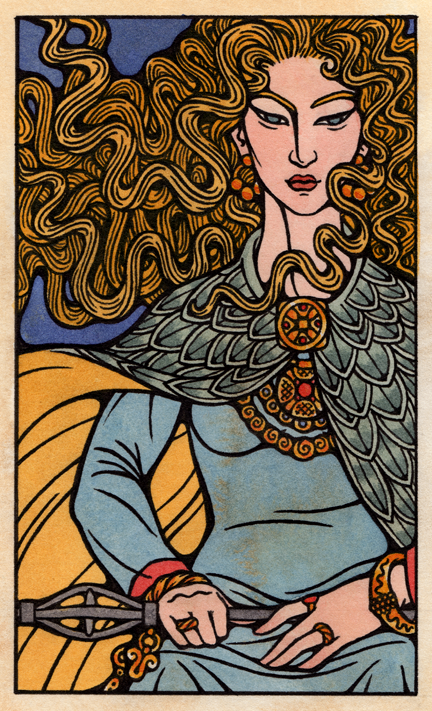

Acca Larentia is a Roman Goddess who is most famous for being
the foster-mother of the mythical twins Romulus and Remus. She is an Earth Goddess
and protectress, and the divine ancestress of Rome, associated with wolves,
the Underworld, and the fertility of the earth and fields.
In a late but widely-known legend, Acca Larentia is the wife
of Faustulus, a shepherd to the King of the time, who found the abandoned infants
Romulus and Remus being miraculously nursed by a she-wolf. They were really
sons of the God Mars, who had come to their mother, the Vestal Virgin Rhea
Silvia in the form of a wolf. Faustulus took them home to his wife, who
then acted as their wet-nurse. Acca Larentia and Faustulus had had twelve sons;
since one of them had died, Romulus took his place. These twelve brothers under
the supervision of their mother sacrificed annually in the fields (the arvae)
to bring fertility to the crops, and were said to be the foundation of the twelve-man
brotherhood of the Arval priests.
Sometimes Romulus and Remus are said to have been nursed by the
Wolf-Goddess Lupa or Luperca, who was identified
with Acca Larentia. In this version Luperca's husband is the Wolf- and Shepherd-God
Lupercus who brought fertility to the flocks, and through His rapport with the
wolves, kept them from harming the sheep. The Lupercalia
was the festival of Lupercus, and was concerned with fertility and purification
of both the flocks and the City of Rome. Wolves and sheep come up a lot in these
legends concerning and glorifying the origins of Rome--for the city was believed
to have been founded by a clan of shepherds who settled on the Palatine Hill,
and Romulus and Remus were shepherd-kings.
In another tale, Acca Larentia is a notorious and beautiful prostitute
who was shut up in the temple of Hercules overnight. There She dreamed that
Hercules came to Her, and promised a gift from the first man She met the next
morning. Accordingly, the next day She met a wealthy man who fell in love with
Her and married Her, leaving his great fortune to Her at his death. At Her own
death, She bequeathed the fortune to the city of Rome. In a variation of the
same tale, Acca Larentia gains the wealth not through marriage but through Her
own career as a prostitute in which She is known as Lupa, or "She-wolf",
ancient slang for a prostitute. In either case, the people of Rome were so grateful
to Her that they instituted a festival on December 23rd, called the Larentalia,
where sacrifices were made at a site in the Velabrum (the low-lying little valley
between the Palatine and the Capitoline hills) by the Flamin Quirinalis, the
Priest of Quirinus, aka Romulus, as His foster-mother. This spot was said to
be either the location of Her tomb, or the spot where She disappeared when She
ascended as a Goddess.
Although in most of the Roman tales Acca Larentia is said to
be a deified mortal, She is actually a very old Goddess of Etruscan origin.
She is connected with the Lares (also Etruscan in origin), the household Gods
who protected the family and were sometimes thought of as the spirits of the
benevolent dead. In earliest times, the dead of a household were usually buried
on the family's property, hence the localized nature of the Lares. Her name
among the Sabines is Larunda, to whom She was a house-goddess like the Lares,
and whose festival in December became the Roman Larentalia. As Lara or Mater
Larum She was considered the Mother of the Lars and an Underworld Goddess. In
yet another myth, Lara was a nymph who talked too much; Jupiter cut out Her
tongue, and afterwards She was known as Muta ("the Silent") or Tacita
("the Secret"), also a name for one of the Camenae,
a group of four prophetic Roman Goddesses.
So it seems that Acca Larentia is an old benevolent Earth Goddess,
with both chthonic and fertility aspects. In Her role of Underworld Goddess,
She watches over the beloved dead, protecting them and their living families,
as well as the larger family of the people of Rome, whose mythical founder Romulus
She nourished and sheltered. As Wolf-Goddess She watched over the shepherds
and their kings and brought fertility to the flocks; as Mother of the Dead She
also has connections to prophecy. As the fertile Earth She brings abundance
and bounty to the fields, and in the reference making Her a courtesan one sees
a hint of a Goddess of Springtime and Love; for Acca Larentia was also honored
on the last day of April, a day that fell within the springtime festival of
the Floralia, a wild joyous celebration where prostitutes
were especially honored.
Alternate names: Acca Laurentia, Acca Larenta, Larentia, Laurentia,
Lara, Larunda, Larenta, Larentina, Mater Larum ("Mother of the Lares").
Equated with: Fauna (wife of Faunus,
who had an oracle on the Aventine hill), the Bona Dea,
Lupa, Luperca, Dea Dia.
