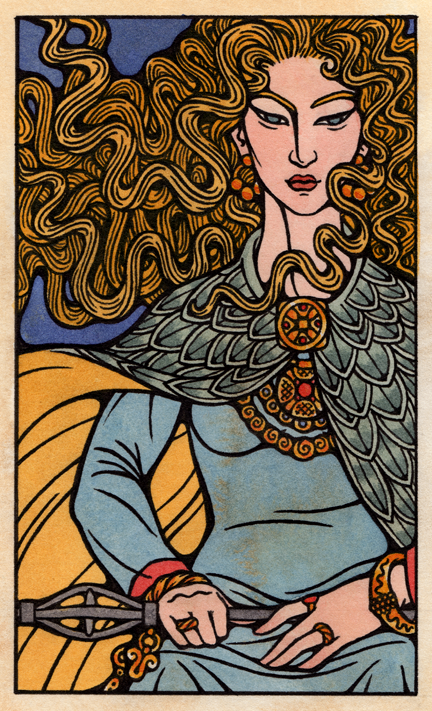

Amaunet is an ancient Egyptian Goddess of Air or Wind, Whose
name means "She Who is Hidden", "The Invisible One" or "That
Which is Concealed". She is one of eight primaeval Deities Who existed
before the beginning of the world, and Who together made up the primordial ocean.
There are several creation myths in ancient Egypt, depending on the place; many
regions had a story of the beginning of the world that featured their local
God. The myth in which Amaunet finds Herself is from the area of Thebes, specifically
the town called Khmun, which is better known by its Greek name Hermopolis ("City
of Hermes", the God the Greeks associated
with the actual Egyptian patron God of the town, Djehuty, who is also better
known by His Greek name of Thoth). The Hermopolitan Ogdoad was of such
importance that the name "Khmun" simply means "Eight Town",
and even today the modern name, el-Ashmunein, is derived from a Coptic word
meaning "eight". As the number four was symbolic of totality to the
ancient Egyptians so eight was even more complete, as doubling it served to
intensify its meaning.
In the creation myth of Khmun, the primeval flood or ocean was
made up of four elements, personified as balanced pairs of male and female Deities:
Infinity (or Formlessness), represented by the God Heh and the Goddess Hauhet;
Darkness, by the God Kek and the Goddess Kauket; Water,
by the God Nun and the Goddess Naunet; and Air or
Hidden Power, personified by the God Amun and the Goddess Amaunet. These eight
Deities swirled in and among the primordial floodwaters until they came together
in a burst of flame to create the first mound of earth, called the Isle of Fire.
The Scribe-God of Wisdom and the Moon, Djehuty (Thoth) then landed on the island
in the form of an ibis and laid an egg from which the Sun hatched, and Time
began. Seven of the eight Deities then left to live in the Underworld, but Amun
stayed behind in the land of the living. According to the people of Khmun, their
version of the creation myth was supposed to be the oldest one, and Khmun was
said to be the very location of the ancient Isle of Fire.
This primaeval ocean, which is an archetypal version of the annual
flood produced by the Nile River, possessed in itself all the elements needed
to make the world, and through its eight Deities found a totality of material
and energies within its chaos.
Amaunet's name is the feminine version of Amun's, but She seems
to be at least as old as He: The first mention of either Deity is as a pair,
in a Pyramid Text dating to around 2350-2345 BCE, during the Egyptian Old Kingdom's
Fifth Dynasty. The "Pyramid Texts" is the name given to a series of
spells carved on the walls of the burial chamber of pyramids (natch) which were
believed to protect the dead King and help him make his way through the afterlife.
The texts (and the Gods mentioned) are quite likely even older than the Fifth
Dynasty, for the spells appear as it were fully formed, and include language
that was archaic for the time. Amaunet (and Amun) in these spells were regarded
as protective Deities: They are adressed as "Amun and Amaunet, You Who
protect the Gods, and Who guard the Gods with Your shadows". Though Nun
and Naunet are described in a similar manner, it seems especially appropriate
for Amun and Amaunet, Who both represent the mysterious and invisible hidden
forces of nature, to give protection through their shadows; implicit in the
idea of a shadow is that things can be hidden there.
When Amaunet was depicted with the other Deities of the Ogdoad,
She, like the other Goddesses, was depicted as a woman with a snake's head;
sometimes the Goddesses' feet were replaced with the heads of jackals. The Gods
of the Ogdoad were shown with frogs' heads: both the snake and frog are associated
with the Underworld, water, and transformation; and jackals additionally are
linked with the dead or Underworld. These eight Deities were sometimes shown
in baboon-form, much like Djehuty sometimes was. Amaunet could also be depicted
in human form, however, and in this guise She was shown wearing the Red Crown
of Upper Egypt (meaning the southern, or upstream, part of Egypt); She sometimes
holds a papyrus staff, which can symbolize both the primeval waters as well
as thriving new life, as the image of the papyrus-plant was used in hieroglyphs
to write the verb "to flourish".
Though Amun was syncretized to the Sun-God Re as Amon-Re and
became one of the most important of all Egypt's Gods, Amaunet seems to have
primarily been a local Goddess of the area around Thebes. Amaunet was apparently
superceded by the Vulture-Goddess Mut as Amun's consort
(though it is sometimes said that Mut is not actually His wife), especially
in Thebes itself. However Amaunet was never fully replaced, and continued to
be worshipped Herself, especially in Karnak, which was Her main cult-center.
In the great temple of Amun there was a colossal statue of Amaunet, and She
had Her own priests there.
Amaunet is depicted in a small temple to Amun at Djamet (the
modern Medinet Habu), just across the Nile from Luxor, dating from the 18th
Dynasty which was begun by the Pharoah-Queen Hapshepsut in the mid-15th century
BCE and continued by her successor/predecessor/co-regent (depending on when
in the reign we're talking) Thutmoses III. The decoration of this temple nicely
illustrates the war between Thutmoses and the memory of Hatshepsut; many of
the reliefs have been altered or defaced, and the names changed in an attempt
to erase Hatshepsut's legacy (though we can still read themnice try, Thutmoses
III!). On one of the pillars from this temple, Amaunet is shown with Thutmoses
III, offering him life by placing an ankh to his mouth. She is depicted wholly
in human form, and dressed in the archaic sheath-dress common to Goddesses,
with the Red Crown of Upper Egypt on Her head. She clasps the upper arm of the
King, who is wearing a headdress typical of Amun, thereby identifying him as
Amaunet's husband. This same temple was built on and added to through Ptolemaic
times, a millenium and a half later, where a door-lintel from that period is
carved with Amun and Amaunet, showing that She was worshipped right up till
the latest times of ancient Egypt. All told, Her worship spanned (at the least)
a good 2300 years.
Amaunet was worshipped as a protective mother Goddess, Who, with
Her roots in the beginnings of time and creation, was believed to play a fundamental
role in keeping the natural forces of the universe going. Amaunet was invoked
in some of the rituals of the King, including the sed-festival, the royal
jubilee that renewed the King's youth and vigor, enabling him to continue his
reign in strength and prosperity. In Her protective role She was considered
a Mother Goddesssome sources call Her the Mother of Re, which with the
linking of Amon and Re made Her both wife and mother of Her husband. As is not
uncommon among Egyptian Serpent-Goddesses, Amaunet was sometimes shown suckling
the King or future King to grant him health and protection. And from Her home
in the Underworld, She and the other seven primordial Deities were responsible
for making sure the sun rose each morning.
In Karnak She was sometimes associated with Neith.
Alternate spelling: Amunet, Amonit
Epithets: the Hermopolitan Ogdoad are referred to collectively as the "Eight
Chaos Gods" and "Keepers of the Chambers of the Sky"
