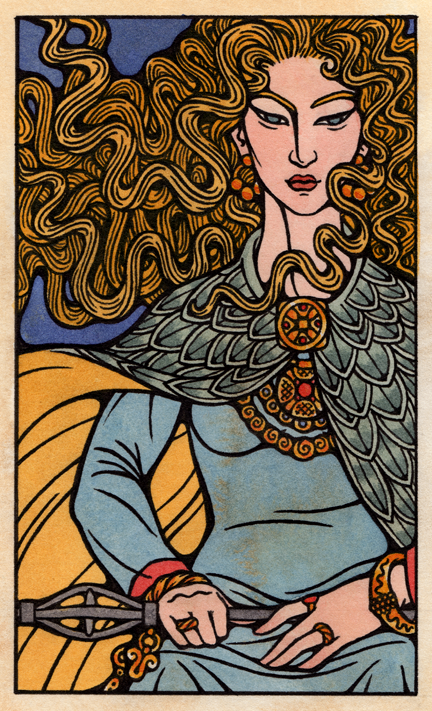

Angitia (the Latin name of the Oscan Anagtia), is an Oscan healing
and snake Goddess who was especially revered by the Marsi, a warlike tribe
of people who lived to the east of Rome in the Apennine Mountains (sometimes
called after them the Marsian Hills) and who spoke a Sabellan dialect. She
was famed for Her ability to heal those who had been poisoned, especially those
bitten by snakes, and She was said to have the power to kill serpents through
spoken charms. The Marsi themselves shared in Her reputation as healers, magicians,
and snake-charmers, and in fact to this day the Serpari, or snake-catchers
of the area are held in high regard. In Rome of the 1st century CE, the Marsi
were reputed to be healers and fortune-tellers, and their land was considered
a hotbed of witchcraft.
Angitia was famous for Her knowledge of healing herbs, and was
honored with both a grove, the Silva Angitia or Lucus Angitiae, and a temple
(complete with treasury) on the south western shores of Lake Fucinus. Lake
Fucinus was a large lake (more than 30 miles in circumference) that had no
outlet and that was prone to overflow onto nearby towns after the spring rains,
which may be why it was drained in the 19th century. Umbro, a legendary priest
and seer of the Marsi, was said, like Angitia, to have been a snake-charmer
and healer who could cure their bites; according to the Aeneid, Lake Fucinus
was said to have wept for him when he was killed in battle.
Angitia's name is believed to be derived either from angere,
"to trouble", referring to Her ability to kill snakes, or anguis,
"snake" or "serpent". Some inscriptions mention Angitia
in the plural as a group, the Angitiae (much like Sulis
and the Sulivae), and in one inscription, She is mentioned with Angerona,
the Goddess of Silence and the Winter Solstice. According to Servius, Angitia
was the name given to the witch Medea, who fled to Italy after her plot to
poison Theseus was discovered. Medea is much associated with sorcery and serpents
or dragons, and so she was identified with the native Marsian snake and magic
Goddess.
The modern Italian region of Abruzzo, roughly the homeland of
the Marsi, is still associated with snakes, epitomized by the Feast of the
Serpari. This feast is first mentioned in medieval times (though it is likely
far older), and is celebrated in the village of Cocullo (population 316!) on
the first Thursday in May. The Serpari are a hereditary brotherhood of snake-charmers
who play a major role in the festival. Sometime around the first day of spring,
the Serpari gather the local snakes (mostly the four-lined ratsnake, a large,
though calm-mannered species that is not poisonous), and bring them back to
the village, where their fangs are removed. They are then kept in wooden boxes
or terracotta jars until the festival and treated well. On the day of the festival,
pilgrims gather in the church of San Domenico to be healed, for, like Angitia,
the Saint is believed to have healing powers, especially in the curing of snake
bites, rabid dog bites, and toothaches. After Mass, the statue of the Saint
is carried from the church in a procession and draped with live snakes, followed
by the Serpari and others of the faithful, also draped with serpents. In earlier
tradition, the snakes were then killed and eaten in a feast (yuck!), but now
bread is substituted, formed into various snakey shapes--some in the form of
twined snakes; others made as interlocking rings of snakes, biting their tails,
ouroboros-like; or made in serpent-form with sliced-almond scales and coffee
bean eyes! Nowadays they are not killed, but released back into the wild when
the festival is over. And by the way, (in case you were worried--I know I was!),
snakes are continually growing new teeth, and will replace lost fangs in as
little as a week, depending on the species.
She is shown here with several four-lined ratsnakes, in front
of Arum dracunculus, said by Pliny to be a cure for snakebites, with
the Marsian Hills in the background. The medium is watercolor pencil.
Alternate names/spellings: Angizia, Anagtia, Anagtia Diiva,
Anguitia, Anguitina, Angitia; Anceta, a Paelignian Healing Goddess is probably
the same name in the Paelignian dialect. The Bona Dea
of Rome is almost certainly the same Goddess, and it is noteworthy that Her
festival is in early May, just like St. Domenico's.
Angitia was also associated with the Greek sorceress Kirke
or Circe.
