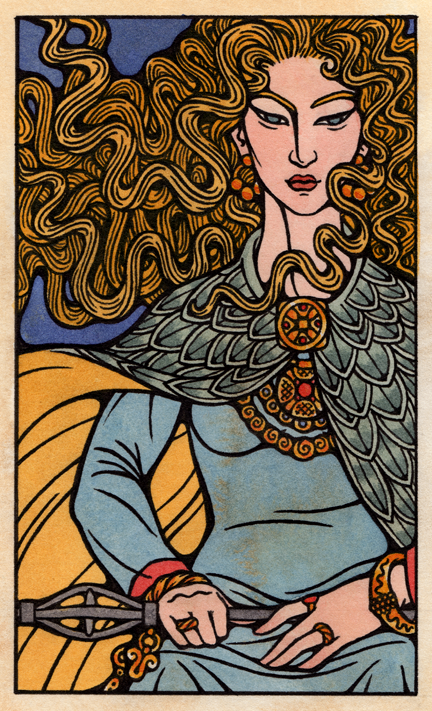

Anna Perenna is the Roman Goddess of long life and renewal,
health and plenty. Her two names both make reference to the year: anna
means "to live through a year", while perenna means "last
many years" (still seen in the English words annual and perennial).
She seems to be concerned with cycles of renewal, and connecting the past to
the present; She Herself is described in some legends as old, and in others
as young. Her festival was held on the Ides of March, the 15th, or midpoint
of the month, when in the old calendar the moon was full--and the timing, both
within the month as well as within the larger cycle of the year, also points
to a relationship with memory, cyclical time, and endings becoming beginnings,
for March was considered the first month of the year when springtime was in
full flower and newness was all around. According to Macrobius, sacrifices
were made to Her with the intent "that the circle of the year may be completed
happily". She is likely an original Italian Goddess of health and longevity,
and perhaps the calendar as well, as She embodies the concept of the moon-calculated
month within the year. Late legends make Her a deified human.
One of these states that Anna Perenna was an old woman from
the town of Bollivae in Latium (the area of central Italy that included Rome).
Historically, in 494 bce, the plebeians (the commoners or peasants), tired
of paying taxes and being conscripted into the military while having no voice
in the government, holed themselves up on the Mons Sacer, or Sacred Mount about
3 miles northeast of Rome, with intentions to secede. They were finally coaxed
back to Rome with the institution of the tribunes, or representatives
of the tribes, whose function was to represent the peoples' interests and defend
their freedoms against those of the patrician class. In the legend, Anna Perenna
brought the plebeians cakes and kept them fed. For these reasons She was always
popular with the common people, and after Her death She was considered a Goddess.
In a later legend Anna is a young woman, the sister of Dido,
Queen of Carthage. After the death of her sister, Anna fled to Rome, where
the hero Aeneas (the cause of Dido's broken heart and subsequent suicide) had
settled. Here she ran afoul of his wife Lavinia, and in despair she killed
herself by drowning in the River Numicius. Afterwards she was said to have
been given the surname Perenna, and worshipped as the nymph of the river. The
River Numicius was considered sacred to Anna Perenna; at its source was built
a temple to Aeneas as Jupiter Indiges (which literally means "Jupiter
the Needy", though no one is quite sure what that is about, as
Indiges or Indigites was a term used specifically for deified mortals), and
at its mouth was the town of Lavinium, said to be named after Lavinia the wife
of Aeneas, who is an ancient local Goddess as well. In fact I suspect that
Anna Perenna and Lavinia may be aspects of the same Goddess; Lavinia was said
to be a prophetess (a common characteristic of water-nymphs), whose father
was one Anius, also the eponymous patron of a river, the Anio. The similarities
of names (Anius, Anio, Anna) as well as the rivalry over Aeneas do suggest
this, as does the fact that to get to the Mons Sacer from Rome one has to cross
the Anio.
In yet another tale, She is again an old woman. The God of War,
Mars, was in love with Minerva, the Goddess of War
and the Arts and a sworn virgin. He asked Anna Perenna to intercide on His
behalf; instead She dressed Herself up as Minerva, and, veiled, came to Mars.
When He tried to kiss Her She laughed and laughed at Him in scorn. Minerva's
main Roman festival, the Quinquatrus, was held just 4 days after Anna Perenna's
and this is usually the explanation given for why they are linked in this legend.
The Festival of Anna Perenna on the 15th of March was beloved
by the common people, though it was also an officially recognized holiday.
On the evening of the 15th, people would gather at the 1st milestone on the
Via Flaminia in Her sacred grove of fruit trees (in bloom at that time of year)
by the banks of the Tiber, and camp out, some bringing tents, others making
little shelters from leafy tree branches. There they picnicked merrily into
the night, feasting, dancing, singing, and celebrating with much wine, toasting
to health and long life. It was believed that one would live as many years
as the cups of wine one could drink, and so it was of course traditional therefore
to get very, very drunk. This festival connected the old and the new; it is
interesting to note that the Via Flaminia was famous for its tombs and cemeteries.
Anna Perenna was equated with several Goddesses: Luna, the Roman
Moon-Goddess (Her name just means "Moon") as the measurer of time;
Themis, the Greek Goddess of Order and a prophetess; the Greek Io, who is also
a Moon-Goddess; or with one of the (unnamed) nymphs who nursed the God Zeus.
