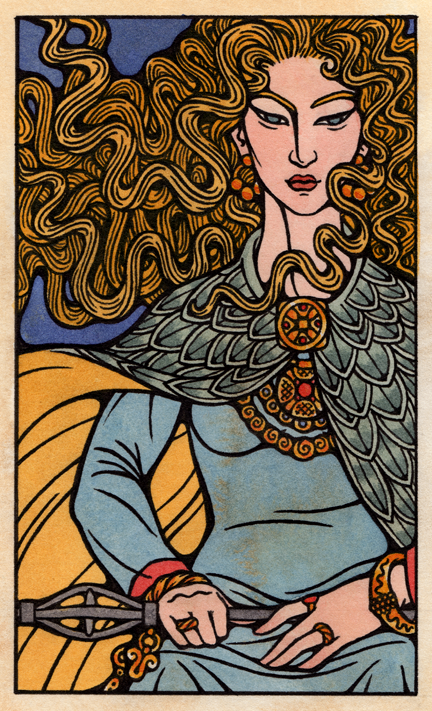

Ashtart (either "the Star", or "She of the Womb"),
is better known by the name Astarte, the Greek version of Her name. Ashtart
is a Semitic Goddess of Love and War and the Canaanite Great Goddess who is
the cult partner of Ba'al ("the King"). Semitic describes a group
of languages, and by extension, kindred cultures of the Near East and Africa
which include Phoenician, Arabic, Hebrew and Assyrian. She is the Deity of the
Planet Venus and a Fertility Goddess, and Her cult was known throughout the
ancient world for its practice of temple prostitution. She was the main Deity
of the cities Sor (more familiarly Tyre), Zidon (Sidon) and Gubla (Byblos),
and is frequently shown as an archer either beside or standing on a lion, much
like the Babylonian Ishtar, who is quite similar.
Snakes and the cypress tree are sacred to Her; and, like the related Arabic
Goddess Al-Uzza, whose name, "the Mighty
One", is an epithet of Ashtart, the acacia tree is also Hers.
As with many of the other Near Eastern Goddesses of the planet
Venus, two of Her aspects are that of the Goddess of War and the Goddess of
Love. As Venus the Morning Star, Ashtart is a Goddess of War and Hunting; and
as the Evening Star, She is the Goddess of Love, Sex, Fertility and Vitality,
depicted as a nude woman. In Her role as Goddess of Love She was honored with
sexual rites, especially in the city of Sidon or Zidon, and some of Her priests
and priestesses there were chosen from the royal family.
In the legends of Ugarit (the modern Ras Shamra on the coast
of Syria) of the 14th century BCE, Ashtart is mentioned with the virgin Warrior-Goddess
Anath (Anat) as restraining
the young God Ba'al, who wishes to overthrow the River God, Yam. When Yam is
taken captive, Ba'al kills him, and Ashtart rebukes him for the murder, cursing
Him with His own name. She is sometimes called "Ashtart-Name-of-Ba'al"
which may refer to Her magical knowledge of His secret name in which His power
resides; the idea of a secret or cult name of a Deity, known only to the initiated,
was not uncommon in the area: Jehovah is supposed to possess a secret name of
power, uttered by Lilith
when She left the Garden; and in a legend of Isis, the great Egyptian Goddess,
She brings about the downfall of the aging God Ra by speaking his hidden name.
Several gold pendants from Ugarit, dating to about 1300 BCE depict
Ashtart in a highly stylized manner. From a flat gold plate, roughly teardrop-shaped,
Her face and breasts emerge; and Her pubic area is depicted as a triangle with
dots, I assume representing hair. There is also, however, what appears to be
a stylized tree "growing" from that triangle and which ends just below
Her navel. This "tree" is perhaps to be equated with the Near Eastern
Tree of Life.
Ashtart was worshipped with the young God 'Adon, son of Malidthu,
in the town of Aphek or Aphaca in Palestine, the modern Afka. 'Adon is a title,
rather than a name (as is common among the Phoenicians) meaning "Lord",
and He may actually be Eshmun, the young God of Health. The site of the town
Aphek was known for its stunning beauty, as it was situated high on a cliff
from which a river issued to fall in a great torrent. Under the Greek name Adonis
(which also means "Lord"), He was a young and very beautiful God with
whom Aphrodite
(the Greek equivalant of Athtart) fell in love. Alas, one day while out hunting
He was killed by a boar and the Goddess mourned terribly for Him. He represents
the young vegetation/crops that are killed in the droughts of the dry season,
and the river at Aphek was said to run red with His blood in the rainy season.
He had a famous festival in midsummer celebrating His death and resurrection
that eventually spread with His worship to Greece, Egypt and Rome, and which
was celebrated primarily by women.
For some time Ashtart under the name Ashtoreth seems to have
been worshipped side by side with the Hebrew God as His consort; He was early
on called Ba'al, a general title meaning "Lord", used in the area
to refer to each people's particular patron God, though their real (and sometimes
secret) names were different. This fell out of favor in time as the Hebrews
transitioned to monotheism. Apparently they had a hard time with this, though,
as Jehovah is forever chiding His people for "backsliding" and returning
to the worship of Ba'al and Ashtoreth. Ashtoreth in the Bible is worshipped
in groves called after Her asherah and may have been honored as a pillar
of wood, or as manifest in the grove itself. In one tale from the Biblical book
Judges, Jehovah has Gideon destroy his own father's shrines to Ba'al and Ashtoreth,
which he does in the middle of the night under cover of darkness, as he was
too scared of the repercussions to do it in broad daylight.
King Solomon, famous for his great wisdom, was said to have had
700 wives, many of whom were from neighboring, Pagan, tribes. To accommodate
their religions, he built for them temples to their Gods, including a sanctuary
to Ashtart in Jerusalem. Jehovah, known far and wide for His jealousy, couldn't
tolerate this and brought about Solomon's death. On other occasions when the
Hebrews reverted to the old religion, Jehovah in a divine fit of pique "gave
them over into the hands of their enemies" (also from Judges).
Ashtart also had temples in Ascalon in Philistia, about 40 miles
southwest of Jerusalem, and Beth-shean, or Scythopolis, near the Sea of Galilee.
She is also said to be the mother of the maiden Yabarodmay,
by Ba'al.
The Goddess Athirat-of-the-Sea,
who also features in the Ba'al legend, is the wife of El, the Father of the
Gods; She has much in common with Ashtart and the two may be aspects of the
same Goddess. Some sources make Athirat the Goddess worshipped by the Hebrews
as Jehovah's consort; the two are quite confused, both by modern scholars and
the ancients.
Ashtart's name has many variations depending on the language
or city in which She was worshipped. Some examples: She is Astarte to the Greeks,
Ashtoreth or Ashtaroth among the Hebrews, 'Attart or 'Athtart in the city of
Ugarit, Astartu in Akkadian.
Epithets: "Goddess of Heaven", "Ashtart-Name-of-Ba'al",
"Ashtart-of-the-Sky-of-Ba'al", "the Strong One", "Ashtart-of-the-Fields",
"Ashtart-of-the-Battle"; and Kbd, "Glory"
She is the western Semitic equivilant of the Eastern Semitic
Inanna of the Sumerians
and Ishtar of the
Babylonians; the Greeks identified Her with their Aphrodite, who may have Her
origins in Ashtart anyway, as She was believed to have come from the East. Atargatis
is confused or equated with Her, and may have originally been the same Goddess;
Ba'alat, "the Lady"
of Gubla (Byblos) is likely a title for Ashtart. She was equated by the Etruscans
with their Mother and Sky Goddess Uni,
and is related to Tanit
of Carthage.
