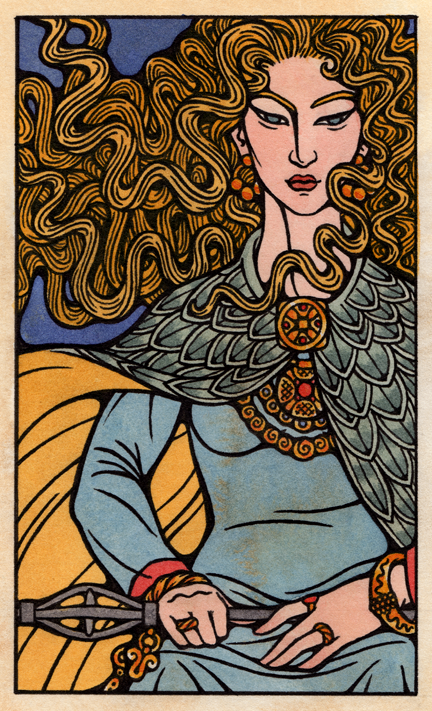

Atargatis is a Goddess of Syrian origin whose worship spread
to Greece and Rome (and further). She is a Great Mother and Fertility Goddess
of the Earth and Water, considered the main Goddess worshipped in Syria. Doves
and fish are sacred to Her: doves as an emblem of the Love-Goddess, and fish
as symbolic of the fertility and life of the waters. She is so closely identified
with the fish that sometimes She was represented in the form of a mermaid--Her
upper half that of a human female, Her lower a fish-tail--though She could also
be represented in simple woman-form. She is the great civilizer, who taught
the people social and religious procedures, and who is responsible for inventing
many useful things as Her gift to Humankind. In Her capacity as Heavenly Goddess,
She is concerned with astrology and divination, and Fate. Though Atargatis is
often identified with Astarte, this is not quite correct--while the worship
of both Atargatis and Astarte spring from a common source, the cults later diverged
so that the Goddesses became distinctly different. By the late periods though
They were so confused in the popular imagination that They did in fact merge
back into the same Goddess. Atargatis may be the direct inspiration for the
Greek Love Goddess Aphrodite,
whose worship is said to have come from the East.
There are a few theories as to what the name "Atargatis"
means. The name is Semitic, and in Phoenician is 'Athtart. The first half of
the name, most agree, is a form of the name Athtar (aka Astarte). The second
part is more problematic, however, and various interpretations of the whole
of Her name are: "Atar the Daughter/Mother of 'Ate", "the Fish
Goddess Atar", or "Atar the Favorable One".
Atargatis was worshipped in Syria in the city of Ascalon, a town
said to be famous for its scallions (literally "onions of Ascalon"),
later called Hieropolis or Bambyce by the Greeks and one of the five main cities
of the Philistines. It was located on the Mediterranean coast about 40 miles
south west of Jerusalem. Herodotus credits Her temple there as being the oldest
temple to Aphrodite (what he calls Atargatis) in the world, and the inspiration
for Her temple on the island of Cyprus. In Ascalon the God Hadad was considered
Atargatis's consort (He was the local Ba'al, or "Lord", as
She was the local Belit or "Lady"), and there the two of them
had a great temple. Lucian, a writer of the first century ce who was born in
Syria, left us a description of the temple of Atargatis. It was richly decorated,
with a golden ceiling and doors, and inside it, the statue of Atargatis was
also made of gold and displayed with Hadad's. While He was enthroned on two
bulls, She sat on two lions (like Astarte), holding in one hand a scepter, in
the other a distaff; around Her waist was a girdle that Lucian identifies with
the cestus of Aphrodite, the magic belt that made Her irresistible when
worn. Her crown was in the form of a tower (the mural crown, signifying possession
or rule over a city) and rays were depicted behind Her head. This statue was
covered with gems and jewels from all over, and in Her crown was a great red
jewel that lit up the room. Lucian also says that no matter where you were in
the room the statue's eyes always looked directly at you.
Not far from Her temple was a sacred lake, filled with many varieties
of fish, Her sacred animal. These fish were well-kept, sometimes even ornamented
with jewels (Lucian says he saw one particular fish that had a jewel in its
fin on several occasions): they knew their names and would come when called,
and would snuggle up to people to be pet. In the middle of the lake was an altar
that people would swim to to make offerings. According to other writers, It
was taboo to eat or touch these fish, except on special occasions and by the
priesthood, who considered it theaphagy, the ritual eating of the Goddess as
a sacrament.
Depictions of the cult-statue of Atargatis of Ascalon on coins
of the first century BCE show an archaic and standardized form, much like other
eastern cult statues like the Diana of Ephesus or the Aphrodite of Aphrodisios.
Her body is stylized as a column in a tight sheath dress with Her arms sticking
out at the sides at right angles. She wears a veil that reaches to the floor,
and holds a flower or ear of corn in one hand. On Her shoulders are two wheat
or barley-sheaves; Her dress is textured with smallish lumps, reminiscent of
grains of barley, with an unidentified oval in the center, perhaps a representation
of the girdle or cestus Lucian describes.
Her priesthood was of the Oriental ecstatic type, rumored to
perform acts of self mutilation and self-castration, much like the priesthood
of Cybele. Also like Cybele's, the worship of Atargatis was practiced with song,
dance, and music of flutes and rattles, the worshippers working themselves to
a frenzy. She was also said to have a temple in Carnion in Gilead (modern north
west Jordan).
The worship of Atargatis spread to other parts of the Mediterranean,
mostly brought by Syrian slaves. The Greeks called Her Derketo (an adapted form
of "Atargatis"), and considered Her the chief Goddess of the Syrians.
She had a temple in Ephesus, where the priestesses were so numerous they supposedly
gave rise to the Amazon legends. One Greek story says that Derketo was a nymph
who loved a shepherd-boy; when She became pregnant by him She either killed
him or threw Herself in a pool in shame, where She was changed to a fish. Another
story says that Derketo was hatched from an egg that fell from heaven; it landed
in the Euphrates river, where some fish nudged it to shore. There it was found
by a dove, who incubated it. Later, to show Her gratitude, Derketo persuaded
Zeus to put an image of the fish in the stars, which He did, creating the constellation
Pisces. The daughter Derketo bore was Semiramis, (who built the Hanging Gardens),
the famous Assyrian Queen of Legend, and who was worshipped in Her own right
as a Goddess in nearby Charchemish.
The cult of Atargatis was first brought to Italy by slaves as
well as mercenaries, and gained a footing in Sicily. From there it spread up
the boot of Italy, helped no doubt by its wandering beggar priests, who would
visit towns with a statue of Her on a donkey to collect alms. The Romans called
Her Dea Syria, "the Syrian Goddess", and considered Her temple in
Ascalon that of their Venus Urania, or Heavenly Venus. She was adopted into
the Roman pantheon and worshipped with Jupiter (who was identified with Hadad)
at a shrine in the grove of Furrina on the right
side of the Tiber. The Via Portuensis, the road from Rome to the port of Ostia,
also had a shrine to the Syrian deities somewhere along the way. Under the Empire,
Her worship continued to be expanded within the Roman lands (and Gaul) by Syrian
merchants. By late Roman times She was considered a great Mother Goddess, equivilant
to Rhea or Cybele.
Identified with: Astarte, Ishtar,
Venus Urania, Hera, Rhea, Cybele, Aphrodite. She
is sometimes also called Artemis Azzanathcona.
Alternate names/spellings: Atergatis, Ataratha, Taratha, 'Atar'arah
(Aramaic), Tr'th (in the Talmud), Atargates, Derceto, Dea Suria, Syria Dea,
Deasura, Iasura.
