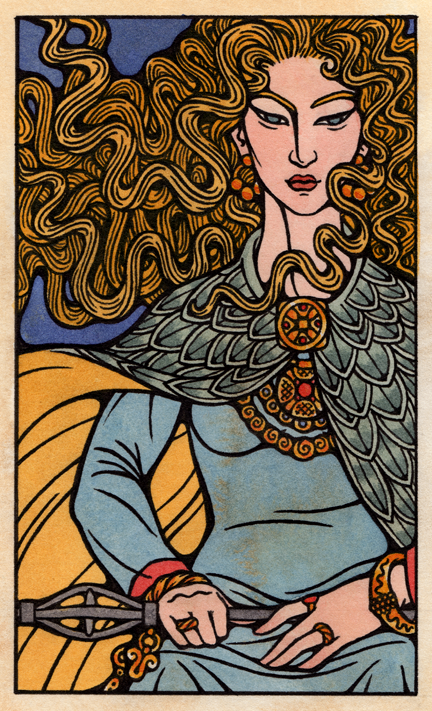

Athena is a very, very old Goddess Whose origins are most likely
pre-Greek. She is so old that the meaning of Her name has been lost; and the
earliest mention of Her name, or what looks like Her name, is from Knossos on
the island of Crete and dates from Mycenean times, somewhere in the 14th century
BCE. It is in Linear B, a syllabic writing system in which the symbols stand
for groups of letters, and which is the oldest written form of Greek known.
On this tablet offerings to four Deities are listed, and the first one is to
a-ta-na-po-ti-ni-ja, or Atana Potinija, which is very similar
to one of Her later titles, (in Greek) potnia Athenaia, meaning "Mistress
Athena", or "Athena Who Masters". However in Mycenean times this
title was mostly (though not always) connected with places, which could make
Atana Potinija mean "the Mistress of Atana"and whether
this "Atana" is the familiar Athens or another similarly named city
isn't known.
Images of a Warrior Goddess Who looks very much like Athena have
been found in Mycenae on the mainland, though She wears the boars'-tusk helmet
of that age; She seems to have been a protectress of citadels and the royal
palace. Athena is intimately bound with the city of Athens and its Akropolis;
the easily-defended Akropolis has been inhabited since Neolithic times (around
5000 BCE), and at the time of the Linear B inscription above in the 15-14th
centuries BCE a palace complex was built atop it, on the site where the later
temple(s) of Athena would be.
Athena was likely worshipped even further back in Minoan times,
though here is where things get rather speculative. The Minoan language, called
Linear A, is famously untranslated, as the language does not appear to be related
to any other known language, and because there just aren't all that many examples
of it. Like Etruscan, another lost language, there are plenty of crazy theories,
most of which seem to be made to fit the translator's own agenda; however, Linear
A is the predecessor of Linear B, and it seems reasonable to me that
some of the symbols would have kept the same syllabic letter-values; if this
holds, then perhaps an even earlier form of Athena's name is mentioned as one
"atanodjuwaja"; djuwaja would then perhaps be the Minoan equivalent
of potinija. I have a sneaking, though unprovable, suspicion that the
so-called "Minoan Snake Goddess" is an early ancestor of Athena: in
later legend, Athena is very strongly associated with snakes, and the somewhat
blobby critter perched on the Snake Goddess's hat, variously called a cat or
a bird, could just as well be an owl, Athena's totem bird.
Athena's mother was generally said to be Metis,
wisdom personified. In the most famous story of Her birth, Zeus
and Metis have sex, and She becomes pregnant; but after She conceives He learns
that any male child of Hers is destined to overthrow his father. Zeus, probably
a bit paranoid due to the circumstances of His own birth, takes the precaution
of swallowing Metis whole. However, now the unborn daughter is also inside Him,
and in time, Athena smashes out of His skull, full grown and armed. Other tales
make Her father Poseidon, the Sea-God, with Whom She was also strongly associated;
or, one Pallas, who tried to rape Her and was killed by Her in defense and righteous
fury.
Athena can be summed up in one word: ability. That ability encompasses
just about everything: wisdom, war, weaving, shipbuilding, dance, athletics,
music, invention, crafts, and technology in general. What it did not include,
for the Greeks, was sex or childbearingin the tales She is very careful
to preserve Her virginity and independence. I suspect, (and again, this amounts
to an unprovable hunch on my part), that Her "virginity" had not been
a part of Her character from the beginning, but that when the Greeks adopted
Her, Her independence, ability, and confidence were just not compatible with
the Greek institution of marriage, in which a wife was not even supposed to
leave the house without her husband's permission. So, the only way they could
reconcile Her strong personality with what they believed of women, was to say
that She was an avowed virgin and would have nothing to do with men.
Athena has many, many epithets and aspects. Articles marked with
an * have illustrations, by me (and you
can reasonably expect some more, since, as I've said, I'm on a wicked Athena
kick lately). Here we go:
Aeantis, Aethyia, Ageleia, Agoraea, Agripha, Akraia, Akria, Alalkomeneis,
Alea, Alkimakhe, Amboulias, Anemotis, Apatouria, Areia, Asia, Axiopoinos, Boarmia,
Boulaia, Contriver, Damasippos, Dea Soteira, Ergane, Erysiptolis, Glaukopis*,
Gorgopis, Hephaistia, Hippia, Hippolaitis, Hygieia, Itonia, Keleuthea, Khalinitis,
Khalkeia, Kissaea, Kledoukhos, Koria, Koryphasia, Kranaia, Kydonian, Kyparissa,
Laossoos, Laphria, Larisaea, Leitis, Lemnia, Mekhanitis, Metros, Narkaea, Nike,
Nikephoros, Onga, Ophthalmitis, Optiletis, Oxyderkes, Paeonia, Pallas, Panakhaia,
Pania, Pareia, Parthenos, Phratria, Polias, Poliatas, Polyboulos, Polymetis,
Poliykhos, Promakhorma, Promakhos, Pronaia, Pronoia, Pylaitis, Saitis, Salpinx,
Skira, Sthenias, Soteira, Souniados, Taurobolos, Telkhinia, Tithrones, Tritogeneia,
Xenia, Zosteria
Note on the spelling: I have kicked all the C's (a Latin convention)
out of the spelling, since they didn't exist in Greek, even to replacing "ch"
with "kh".
