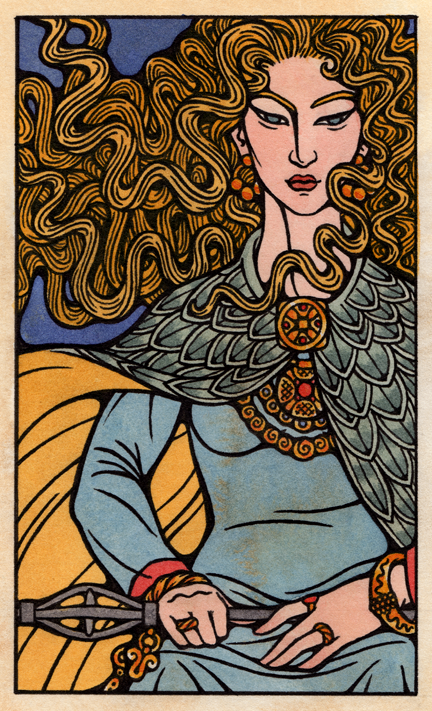

Athirat is the Canaanite Earth and Mother Goddess, called "Creator
of the Gods", who is also known as Asherah. The God El, (the name just
means "God") is Her brother and husband; She is famed for Her great
wisdom and as such acts as El's counsellor. She is known for Her protective
attitude and kindliness towards Her many children, and frequently persuades
El to act on their behalf. She was said to be the mother of the seventy gracious
Gods, as well as the Gods Ba'al and Athtar the Terrible, the King of the Earth
who is perhaps a desert God, Marah, a benevolent Water-Goddess,
and Anat, the Maiden Warrior Goddess. She is often
confused with Ashtart (better known by Her Greek
name, Astarte), as well as Anat, and the three may all represent differing aspects
of the same Great Goddess.
Athirat is associated with the Tree of Life, and a famous ivory
box-lid of Mycenean workmanship found at Ugarit, dating from 1300 BCE, shows
Her as symbolically representing the Tree. She wears an elaborate skirt and
jewelry, and though topless Her hair is delicately dressed; She is smiling,
and in Her hands She holds wheat sheaves, which She offers to a pair of goats.
When El was young, he came across two beautiful Goddesses washing
their clothes in the Sea. They were Athirat and the Goddess Rahmaya,
and, after buttering Them up by cooking a meal for Them, He asked them to choose
between being His daughters or wives. They choose the latter and became the
mothers of the Gods Shachar "Dawn" and Shalim "Dusk". Rohmaya
is evidently a double of Athirat, and perhaps these two aspects of the Mother
Goddess bear some connection to Ashtart as Goddess of Morning and Evening Stars,
i.e., the planet Venus. (Shalim is considered in some lineages to be the father
of Helel, the "Light Bringer", in Latin, Lucifer, the Morning
Star.)
Athirat is a key player in the 14th century BCE Epic of Ba'al.
In this tale, the River-God Yam has been made King of the Gods by His father
El; but His rule was harsh, and the Gods begged their mother Athirat to intercede
for them. She offers Herself to Yam, but Ba'al Her son will not hear of it;
instead He sets out to destroy Yam Himself. After He succeeds, He laments that
He has no palace, as befits a son of the Goddess Athirat. He entreats Her to
get El's permission to build this house, which She successfully does. In this
Epic of Ba'al it is important to note that Athirat, Ashtart and Anat are seperate
and distinct Goddesses with their own roles and personalities.
Athirat is a powerful Goddess, and many times the other Gods
ask for Her to help Them, or to try to influence Her husband El for Their good.
As the keeper of Wisdom She is the one who chooses the successor to Aleyin (an
aspect of Ba'al as the dying vegetation God), and after His death She instructs
Anat in the proper ritual needed to ensure the fertility of the vines.
She is connected with the Sea, as She is said to live by its
shores; and Her sons are called "the Cleavers of the Sea": She was
invoked to protect sailors and sea-farers.
She shared El's temple in Ugarit (the modern Ras Shamrah) and
many representations of Her are known from that site. She was considered the
consort of Ba'al-Hadad in Syria and had a temple there. The Ashtoreth of the
Hebrew Scriptures, worshipped along with Ba'al as a divine pair, may refer to
Athirat the Mother Goddess, or to Ashtart (Astarte). There is much confusion
on the subject, among both ancient and modern sources, and it's likely I'm just
as confused, though I have done my best. As "Ba'al" is properly a
title meaning "Lord" and was used of differing Gods depending on the
location, it is quite possible that what is meant in the Bible by "Asheroth"
simply refers to the local chief Goddess as the consort of Ba'al or El, which
in some places would be Ashtart, in others Athirat. See Ashtart
for the Biblical references.
Like Ashtart, Athirat is associated with the lion. She is generally
shown as a nude Goddess with curly hair cupping Her breasts with Her hands.
She is also associated with the snake, and an alternate name for Her is Chawat,
which in Hebrew transliterates to "Hawah", or in English "Eve";
so She may well be the root of the Biblical Eve. Like the later Carthaginian
Goddess Tanit, whose name means "Serpent Lady",
Athirat was represented as a palm tree or pillar with a snake coiled around
it, and the name Athirat derives from a root meaning "straight".
Atargatis of Syria is likely a late
combination of or confusion with both Athirat and Ashtart/Astarte.
Alternate spellings: 'Athirat, Airat, Asherat, Asherah, Sherah.
In the Ugaritic texts She is called Ashertu, and called the unfaithful wife
of Elkunirsa, a forerunner of El. The Hittites knew Her as Ashertus or Asertu;
to the Amorites She was Ashirta; and to the Akkadians She was Ashratum.
Titles: "Athirat-of-the-Sea", "Lady of the Sea",
"Mother of the Gods", "In Wisdom the Mistress of the Gods",
"Mistress in Wisdom", "Lady Who Treads Upon the Sea"; Elat
or Elath, "Goddess" (this likely makes Her related to the Arabian
Goddess Al-Lat); Labi'atu, "the Lion
Lady"; Dat ba'thani, "Lady of the Serpent"; Rabat Chawat 'Elat,
"Great Lady Eve the Goddess"; Qadshu or
Qadesh, "Holy" is a title used of Her as well as Anat. In the Sinai
She was given the epithet "Lady of Turquoise", and the Egyptians equated
Her with their Hathor.
