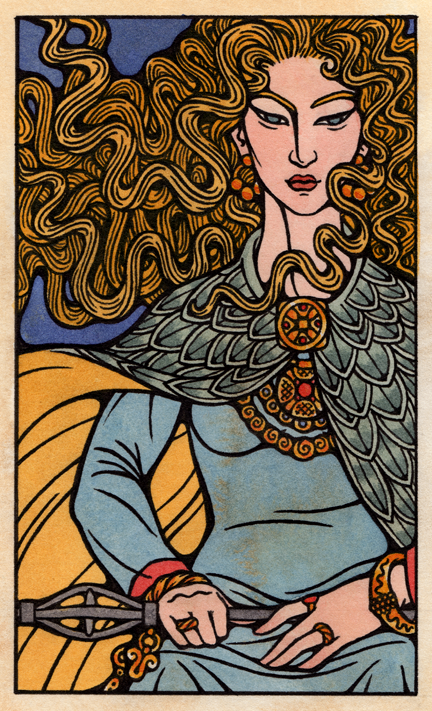

Caia Caecilia, also called Gaia Caecilia, is a Roman Goddess
of Fire, the Hearth, Healing, and Women. Two seperate, though ultimately linked,
Goddesses were known as Caia: Caia Taracia, and Caia Caecilia, also known as
Tanaquil, an early Roman Queen (though some said Caia Caecilia referred to Tanaquil's
deified daughter-in-law, rather than Tanaquil herself). Caia Taracia was a Vestal
Virgin who was remembered for having given a large amount of land to the city
of Rome; much like Acca Larentia, She was honored
for the gift after Her death, and a statue was dedicated to Her. There is evidence
that the stories of Acca Larentia and Caia Taracia are from the same root--one
of the territories (ager) given by Acca Larentia to Rome was called the
Ager Turax, and "Turax" is a version of "Taracia".
Caia Caecilia was the Latin name of the famous Queen Tanaquil,
wife of Tarquinius Priscus, said to have ruled from 616-578 BCE; the Etruscan
name "Tanaquil", which means "the Gift of Grace", may possibly
have been corrupted to "Taracia". Tanaquil was an ambitious, intelligent
woman who was born of a noble family, who was well-educated in medicine and
mathematics, and who was highly skilled in the Etruscan arts of augury and prophecy.
She is credited with acquiring the throne for Her husband and predicting his
rise to power: as they were riding to Rome, a great eagle swooped down and grabbed
his hat; after flying very high it brought it back to him, and Tanaquil correctly
interpreted this as meaning he would achieve great things.
Tanaquil also interpreted other omens relating to the kingship:
one day Her servant-woman Ocrisia was offering cakes to the Lares (the household
Gods) at the family hearth. Within the flames she saw a vision of a God, and
related the experience to the Queen. Tanaquil told her to dress as a bride and
shut herself in her room. That night Ocrisia was visited by a God (some say
Vulcan, the God of Fire, some say one of the Lares), and became pregnant, later
giving birth to a boy. This same boy, another legend says, was once observed
to have flames around his head as he slept; Tanaquil recognized this omen also,
and predicted that he was a future King. Which was true as well, for the boy
was Servius Tullius, who would become the sixth King of Rome.
Tanaquil not only helped Her husband to attain the throne of
Rome, but helped Servius to gain that title after Tarquinius was murdered by
a rival faction. Tanaquil's plan was this: by pretending that the King was only
wounded, Servius was allowed to slip into the role of interim ruler, and by
the time it was announced that the King was dead (long after he actually had
died), Servius had been accepted by the Senate as King.
Etruscan women were known for being confident and strong--an
example of this is found in a quote from one of Servius's two daughters, both
of whom were called Tullia. Though they shared the same name, one was ambitious
and the other not at all: the ambitious daughter complained that her mousey
sister lacked "the daring proper to a woman". Both parts of the name
Caia Caecilia come from an Etruscan root cae or cai meaning "happy"
which in Latin gave the common male name of Gaius. Caia Caecilia is an exception
to the usual rule by which Roman women were named: generally, in the early times
anyway, Roman women had one name only, which was the feminine form of their
father's name, which explains why Servius Tullius's two daughters were both
named Tullia. Infrequently, women would acquire a first name upon marriage,
which would then be the feminine form of her new husband's name. Tanaquil took
neither, and in fact is sometimes considered to be more famous and powerful
than Her husband.
After Her death, Tanaquil was deified and perhaps assimilated
to an earlier Goddess Caia. The deification of a mortal, though mocked in the
time of the Empire, was not really that big a leap, religiously. The dead had
long been given divine honors, as they were considered to be immortal, and the
spirits of the ancestors were given offerings as a regular part of family worship.
Both the Manes and the Lares, the guardian Gods of the household who feature
in Caia's legend, find their roots in the spirits of the dead.
Caia's name shares its root with the name of Caeculus, a son
of Vulcan, who was said to have founded the city of Praeneste. Caeculus's story
shares many of the same motifs: it was said that his mother, a shepherd-woman,
was seated by the hearth when a spark jumped out and landed in her lap, making
her pregnant by the God Vulcan. Later as a young man, Caeculus asked for a sign
from his father to prove his divinity, and Vulcan answered by surrounding him
with a ring of flames, much like the omen seen around the boy Servius. Caeculus's
story sounds like a different, probably older, version of Servius's that may
have been appropriated by Rome to glorify their early history--the Romans were
forever inventing propaganda to show that Rome had always been destined
for greatness--for Praeneste is the older city.
Caia as a Goddess of Women played a part in the Roman wedding
ceremony. As part of the ritual, the bride and groom exchanged similar vows,
the bride's being, Ubi tu Gaius, ego Gaia, meaning "Where you are
Gaius, I am Gaia" (the groom's counterpart would of course be, "Where
you are Gaia, I am Gaius"). Perhaps this can also be interpreted to mean
"When you are happy, I am happy", for it was thought that invoking
Caia would bring good luck to a marriage. And after the bride was married, but
before she had officially entered her new home, if she were asked her name,
it was traditional for her to answer "My name is Caia". The Romans
honored Caia/Tanaquil for Her domestic skills, as fit their ideal of women,
and in one of the (zillion and a half) Temples to Fortuna
in Rome a toga She had woven for Servius Tullius was kept. Likewise, in the
Temple of Semo Sancus (a God of Sabine origins) Her spindle and distaff (tools
used in spinning yarn) could be found, along with the bronze statue of Caia
Caecilia. Filings from this statue's sash were believed to have healing powers.
Additionally, Caia Caecilia is connected to Tiberius, the God
of the Tiber River, which runs through Rome. She is also linked to the island
in the middle of the Tiber, and may have had a small shrine there with Tiberius,
where offerings were made to Them on the eighth of December. The Island was
said to have been created when the Tarquins were finally run out of Rome, as
Rome transitioned to the Republic; the people in their anger at the old Kings
took all the grain from the fields that had been owned by the Tarquins and dumped
it into the Tiber, creating the island. One of the earlier Tarquins, of course,
had been Tanaquil's husband.
So then: Caia's various legends and connections are quite tangled,
but there are some common threads--She is associated with the Lares and the
hearth-fire, with Queenship and prophecy, and the land. It is noteworthy that
Gaia Taracia was a Vestal Virgin, one of a priestesshood who served Vesta,
the Fire-Goddess of the Hearth. Fire plays a part in many of the legends woven
about Caia, and fire is used as emblematic of divinity in the story of Her male
namesake, Caeculus: given Her Etruscan origins and the tales of Her exploits,
it is tempting to see it as "the fire in the belly" of daring and
audacity. Her connections with Acca Larentia (the Mother of the Lares) and the
Lares themselves place Her at the Hearth, symbol of the center--of the home,
or the State, as Vesta's temple in the Forum was the symbolic "central
hearth" of Rome--and tie Her to the land, as the Lares were farmland-spirits
in addition to spirits of the dead (for the dead were in early times buried
on the family's land); She donates land to Rome, thereby increasing its size,
and Her family is at the bottom of a legend about creating land. She is likely
then a Goddess of the territory of Rome, and a patroness of the Roman people;
and as the Queen who represents the land, She gives the divine right of rule
through Her gifts of prophecy, and acts as mother or Godmother to Kings.
The Romans, in adopting this Etruscan Deity, emphasized Her domestic
household skills in accordance with their ideals, and invoked Her blessing over
marriages and brides. Caia's fiery roots may not have been forgotten, though:
the most important piece of a bride's wedding apparel was her veil, called a
flammeum, so-named because it was the color of fire.
Also called: Gaia Caecilia, Gaia Taracia, Gaia Fufetia, Tanaquil,
Thanxvil
