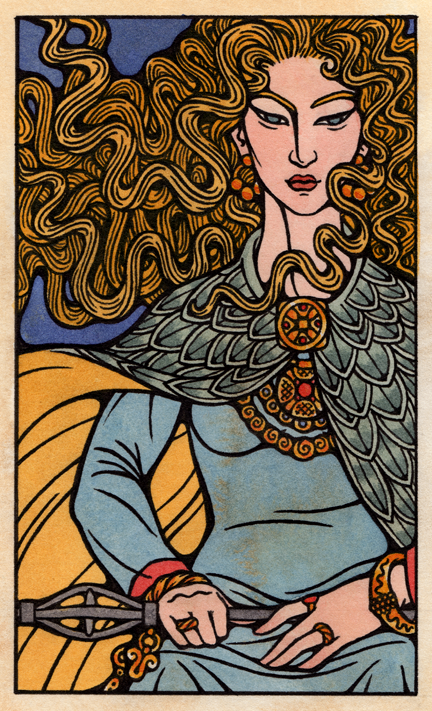

Cels is an Etruscan Earth Goddess Who makes the grain grow tall.
As is not uncommon among Earth Goddesses specifically or Etruscan Deities in
general, She has connections with the Underworld and with Fate. She is also
mentioned as a Sun Goddess in some sources; what is clear is that She is the
Etruscan forerunner of the Roman Grain Goddess Ceres.
Her name means "Earth, Ground, or Soil", and comes from an Etruscan
root kel- or kil-, "to grow". Related words in Etruscan
are cele "large, tall, grown", celthi "augmentation,
celebration" and celutule "grown, developed", giving Her
name the rough meaning of "The Earth That Causes Growth". She was
also known as Cel Ati, "Mother Earth", and She was worshipped at the
town named after Her, Celthi, on the northern shores of Lake Trasimene, the
modern Lake Trasimeno or Lake Perugia. There is a bronze statue dedicated to
Her from Castiglione del Lago, on the western shore of the same lake; whether
it came from Her sanctuary at Celthi or from another nearby town is not known.
The Etruscan month corresponding to the Roman September was named
Celius after Cels as Earth and Harvest Goddess, and indicates the time of year
when the grain is grown or ripe and ready to be cut.
Cels also had a role as a Goddess of the Underworld in the interpretation
of omens. The Etruscans were famed for their working knowledge of divination
and augury, and in taking omens divided the sky into four regions, along a north-south
line (called by the Romans the cardo), and an east-west line (the Roman
decumanus). The cardo (see also the Axis- and Hinge- Goddess Cardea)
and decumanus were incidentally later inherited into Roman ritual and
were the first things marked out when establishing new towns in a proper and
auspicious manner.
In Etruscan augury, the diviner would stand in a sacred space
and imagine himself at the crossing of these imaginary lines. He (or she, as
Tanaquil can attest) would then face south and
observe in which region of the sky the portents (which could be the flight of
birds, lightning strikes, &c) were located. The four main parts of the sky
were further subdivided to make sixteen regions in all. Behind the diviner was
the region called the pars postica (the "back part"), the section
of the sky ruled by the Deities of the Underworld and Fate; in front of him/her
was the pars antica (the "front part"), where the Gods and
Goddesses of the Earth and Nature made their home. To the diviner's right (the
west) was the pars hostilis (the "enemy part", considered unlucky)
and to his/her left the pars familiaris (the "friendly part",
lucky). The quarters made where the Deity and luck halves overlaid each other
had varying degress of auspiciousness: the southwestern quarter was believed
to be the most unlucky space, and was called the regiones dirae or "the
fearful regions". In this region Cels or Cel Ati ruled over one part of
the sky.
What that means for Her personality I'm not sure; Grain Goddesses
are usually considered benevolent, though even Demeter has Her dark
side as Underworld Goddess. Perhaps Her position in that section of the
sky is meant to indicate that portents from that region are to be interpreted
as bad luck for the crops or growing grain.
An antefix (a decoration affixed on the roofline of a temple)
from Velsna (Latin Volsinii, modern Bolsena), shows two Goddesses who are labelled
Mera (Menrfa) and Cilens. Mera is clad in Her usual
helmet and breastplate; the figure of Cilens, though missing Her head and left
hand, is heavily draped in chiton and himation, much like the typical portrayal
of Demeter, the Greek Grain-Goddess. Cilens or Celens may be a variation of
Cels's name; alternately, She may be a seperate deity (having, like Cels, connections
to the Underworld) or, as on the Piacenza liver, "Cilens" may even
an epithet of Tinia (Jupiter)!
Alternate names: Cel, Ati Cel. Also sometimes Apa Cel, or Father
Earth, so S/He could go by either gender.
She is closely related to the Oscan Earth-Goddess Kerri. Celsclan,
an Etruscan giant identified with Hercules, is Her son.
