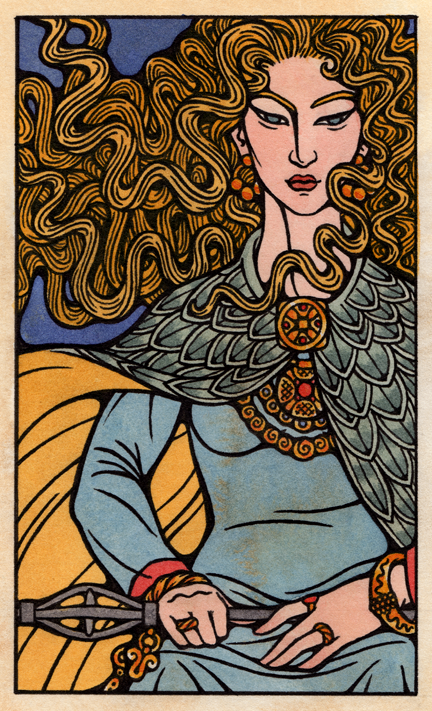

Concordia is the Roman Goddess of Harmony. Unlike many other
Goddesses Who were deified qualities, Concordia was worshipped from early times
in Rome. She especially symbolized peace and agreement between the two classes
of Rome, the plebeians or commoners, and the patricians or nobles. In the early
days of Rome the two classes had joined to drive out the tyrannical Kings and
created a Republic; but it quickly became a Republic of the patricians who had
all the wealth and power. The plebeians were barred from the Senate and other
governmental and priestly offices, though they of course made up most of the
army. In 494 BCE the plebeians had had enough, and, refusing to serve in the
army anymore, deserted and camped out on a hill near the Anio River that they
called the Mons Sacer, or the Sacred Mountain. The patricians, left defenseless,
came to some kind of sense and reforms were instituted giving the plebeians
more rights.
To commemorate the compromises worked out between patricians
and plebeians, a temple to Concordia was built in the northwestern end of the
Roman Forum, backed up against the Capitoline Hill, near the Volcanal, a raised
area that housed an altar to Vulcan. This temple was originally vowed in 367
BCE by the general Camillus and dedicated on July 22nd (which became Her festival)
sometime afterwards. There was a statue of Victoria
on its roof that was struck by lightning at one time; and the temple was restored
in the 2nd century BCE. It was again restored by the Emperor Tiberius, who reopened
it on the 16th of January, 10 CE, dedicating it to Concordia Augusta, the "Harmony
of the Imperial Family". This temple was of somewhat unusual proportions
due to the constraints of the site, but it was accorded one of the most beautiful
in Rome, as it was finely made and entirely faced in marble. In later times
it served as a museum of sorts, and many famous works of art were housed there.
Besides Her great temple in the Forum, Concordia had another,
smaller temple on the Arx, the old citadel on the height of the Capitoline Hill,
which was within sight of the larger temple to Concordia below it. Its dedication
date was the 5th of February, and had been vowed by the praetor Manlius (a praetor
being a kind of consul in charge of the armies) in 218 BCE after a rebellion
among his troops was averted. She had another small temple, credited to the
Empress Livia, probably in or near her colonnade, the porticus Liviae.
It is called by the epithet magnifica ("splendid", "magnificent",
or "sumptuous") by Ovid, and even though it can't have been very big,
it must have been richly decorated. A temple to Concordia Nova ("New Harmony")
was approved by the Senate in 44 BCE, and was to have been built in honor of
Julius Caesar, though his assassination kind of put the kibosh on that and it
was probably never built.
Concordia had a small bronze shrine near Her great temple in
the Forum, set up in 304 BCE, but it is likely that it was demolished when the
temple was expanded in the 2nd century BCE. It had been built by Cnaeus Flavius,
an aedile who had published the very secret list of which days in the year were
(ritually) acceptable for law cases to be heard. As cases heard on the wrong
days were automatically dismissed, the fact that this calendar was jealously
guarded by the patricians meant that plebeians submitting claims had a pretty
good chance of having their claims denied out of hand. After Flavius published
this calendar, the patricians were not at all happy with him, and he vowed the
altar to Concordia to try to help smooth things out. The senate stuck it to
him, though, by not requisitioning any funds to build it, and he had to use
fines collected from money-lenders.
Concordia had a place in the festival of the Caristia or Charistia
(meaning "Pardoning") of February 22nd, a holiday celebrated by families
in which it was traditional to reconcile differences and to mend quarrels or
feuds within the family. Concordia was invoked for Her powers of bringing harmony
and agreement, and other Deities invoked at the Caristia were Janus, the double-faced
God of New Beginnings, Salus, the Goddess of Health,
and Pax, Goddess of Peace. These four Divinities were
honored with statues grouped together at the Altar of Peace (not the great big
famous one built by Augustus, but a smaller one whose location is unknown).
They were also said to be worshipped together on the 30th of March and the 30th
of January, and Concordia was invoked by matrons on April 1st at the Veneralia,
the festival of Venus Verticordia, along with
Fortuna and Venus Herself.
In the later days of the Empire, Concordia was worshipped as
the bringer of marital harmony within the imperial family, and as such was called
Concordia Augusta.
She was depicted as a matronly woman, veiled and heavily draped,
holding an olive branch, emblematic of peace, and a cornucopia, to symbolize
the abundance that can be achieved when people work together in harmony. She
sometimes wore a crown and held a sceptre, caduceus, or patera, a small offering
bowl from which libations were poured. She is associated with the stork, which
symbolized family devotion to the Romans, and the dove, universally a symbol
of peace and gentleness; and sometimes a star, as emblem of hope, is shown near
Her. Another attribute of Concordia is the image of two clasped hands, both
of which are right hands (like in a handshake), symbolizing two people agreeing.
She is often shown on coins commemorating joint rule of leaders or the marriages
of the imperial family.
The so-called Temple of Concordia in Akragas, Sicily, is a Doric-style
temple built by Greek settlers to the island in the 6th and 5th centuries BCE.
Though it is beautifully preserved, and the whole area is now in fact a World
Heritage Site, the identification with Concordia is most probably wrong.
Inscriptions on coins refer to different applications of Concordia;
these were probably not epithets, but rather illustrations of types of harmony,
but I list some of them here: Concordia Militaris, "the Harmony of Armies",
Concordia Provinciarum, "the Harmony of the Provinces", Concordia
Conjugalis, "Harmony of Marriage".
She was identified with the Goddess Homonoia, the Greek personification
of harmony.
