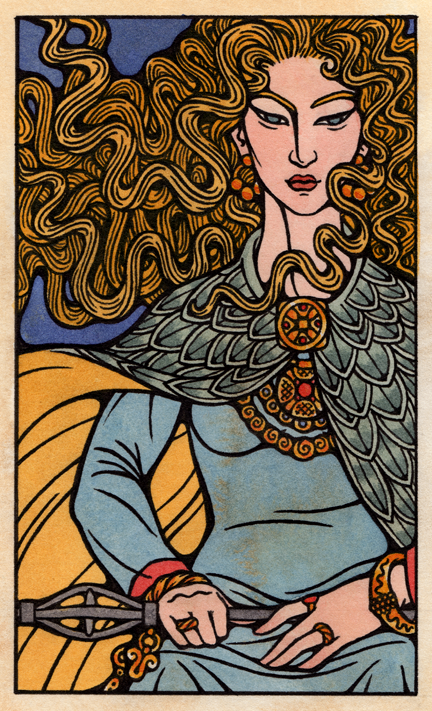

Curitis was originally a Sabine Goddess of Protection who especially
guarded or watched over the clans of the people. She was worshipped by the neighboring
Faliscans, an Etruscan people whose main city was called Falerii, and who though
Etruscan spoke a dialect closely related to Latin. She was the main Deity of
Falerii and considered their patron Goddess who protected the city. Curitis
was assumed to be a form of Juno by the Romans, who called Her (oddly enough)
Juno Curitis; but considering the manner in which She was usually depicted,
an identification with Menrfa (Roman Minerva) or Athene
would seem more logical. Like Minerva, who adopted Her image from the Greek
Athene, Curitis was depicted as a martial Goddess who carried a spear and shield,
and who wore a goat-skin mantle much like the aegis of the Greek myth,
which was a short goat-skin cape or shield probably symbolic of the thunderclouds,
as the spear was of the lightning. Curitis's name is from the Sabine word curis
and means "Of the Spear"; in addition to its stormy associations,
the spear was also seen as representing authority or command, emphasizing Her
role as the ruling Goddess.
It is not known if the Faliscans themselves originally saw Curitis
as an aspect of their great Mother Goddess Uni, or just how She got assimilated
to the Roman Juno; perhaps the Romans took Her position as head Goddess to mean
She must obviously have been their Juno, the Queen of the Gods. As I said above,
Curitis certainly does share more than a few similarities with Menrfa; but according
to tradition, when Falerii was destroyed by the Romans in 241 BCE, their Menrfa
was officially brought to Rome under the name Minerva Capta, or Minerva the
Captive. Falerii was home to a cult-center of Menrfa, though it has not been
determined which of the several temples found there was Hers. The temple of
(Juno) Curitis, however, has been identifed with the largest temple there, and
dates to the 5th century BCE. It is of a tripartite Etruscan design, much like
the Temple of the Capitoline Triad in Rome which housed, with Jupiter, both
Minerva and Juno. This temple was built over the remains of an earlier one,
and votive offerings found there date back even further, attesting to the importance
of the site and to the Goddess worshipped there. Curitis may have been brought
to Rome at the same time as Minerva Capta with the destruction of Falerii; by
that time, Curitis and Menrfa were evidentally seperate deities (if they ever
were the same): the evidence is quite tangled, but perhaps they had originally
derived from a common Goddess. At any rate, both Minerva and Juno were Sky-Goddesses
who traditionally had the power to throw thunderbolts.
In Rome, Juno Curitis was considered the Goddess of the curiae,
the political, religious, and familial divisions or clans of the people of Rome.
Curia most likely derived from the same Sabine word curis, "spear",
as the Goddess's name; and a related word quirite, "spearman"
or "warrior", was used of the oldest tribal peoples of Rome. The 30
curiae were traditionally said to have taken their names after the women who,
in the legendary past of Rome's founding, were abducted from the neighboring
Sabine tribe in the episode usually known to history as "the Rape of the
Sabine Women". The curiae were taken from the noble class (no plebeians
need apply), and each curia had its own specific religious duties and Gods (though
all worshipped Juno Curitis), as well as their own building in which to worship
and meet to discuss political or religious matters. The altar within this building
was called a mensa ("table") and was considered sacred to Juno
Curitis, who was honored by the curiae with special feasts at which first fruits
were offered and a simple supper of wine and cakes made with barley and spelt
were served. As the curiae themselves had Sabine origins, it is likely that
the Goddess Curitis was specifically a Goddess of the people or nobility from
very early times. A prayer to Her, from the region around Tibur (modern Tivoli)
goes as follows: "Juno Curitis, protect my fellow natives of the curia
with your chariot and shield." Another related word in Latin is curius,
a legal term for a man who is responsible for the welfare of someone who under
Roman law was not considered legally able, such as a minor, which indicates
the sort of relationship Juno Curitis was believed to have with Her people.
The Sabine name for the God Mars was Quirinus, which also comes
from the same root meaning "spear" or "lance". In the Sabine
tale He was the father of the founder of their capital city Cures. The same
legend was told of Mars as the father of Romulus, and Quirinus was adopted into
Roman religion, either equated with Mars or used as the name for His deified
son Romulus. Now the mother of Mars was Juno, who was believed to have conceived
Him parthenogenetically by holding a magical flower to Her breast. As they are
both of Sabine origin, have names stemming from the same word, and as their
counterparts are said to be related in later Roman myth, one wonders if Curitis
and Quirinus were originally cult-partners among the Sabines, who were worshipped
either as mother and son or as husband and wife.
Juno Curitis had a temple in Rome, dedicated on the 7th of October,
in the Campus Martius. The Campus Martius (or Field of Mars) was a large flat
piece of land, mostly treeless and hard by the Tiber; it was rather prone to
flooding as it was low-lying. It was bounded on one side by the Quirinal Hill,
named for a shrine to Quirinus; and the field itself was dedicated to Mars and
considered public land, at least in the early times. As it was a large space,
the army assembled there, and another War-Deity, Bellona,
had Her temple there. It is not known quite where in the Campus Martius the
temple of Juno Curitis stood, though it may be one of the temples in the modern
Area Sacro di Largo Argentina.
Ovid, a poet writing under Augustus, who wrote one of the first
books to be banned in history, the Ars Amatoria ("the Art of Love"),
tells of the festival to Juno Curitis he attended in Falerii. Games were held
in which young men threw spears at a she-goat (whoever hit it would get the
meat as a prize), the local cattle were shown, and a procession was held that
ended at the Temple of Juno. White cows were led, followed by calves, then a
pig and a ram for sacrifice; and boys and girls threw flowers. The girls, Ovid
mentions, were dressed all in purple with gold and gems bound in their hair;
and behind them the priestesses, dressed in white, carried the cult-statue of
Juno.
In addition to being a Goddess of the people or curiae,
Juno Curitis was believed to protect mothers and married women, and to keep
their children healthy and strong. The snake was sacred to Her, and sacrifices
were made to Her at the Fornacalia, or the Festival of Ovens.
Also called: Juno of Falerii.
Alternate spellings: Curritis, Quiritis; Curitia may refer to
Juno primarily in Her role as Goddess of the curiae.
