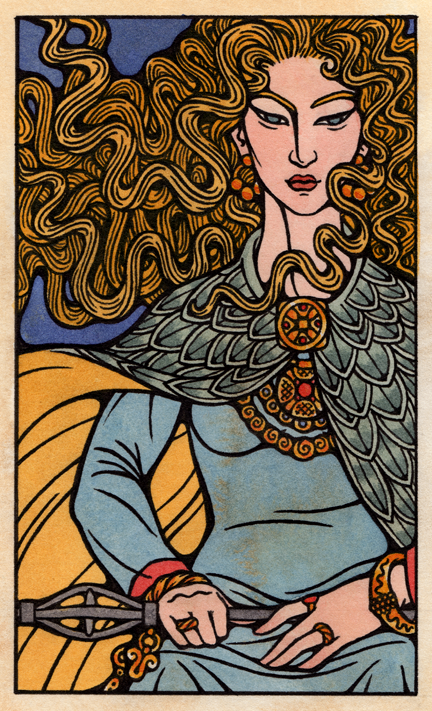

Dea Dia is a very ancient Roman Goddess of the plowed field Who
is concerned with the fertility of the earth and the growth of the planted crops,
especially grain. Her worship dates back to early times, and is of either Latin
or Sabine origin; She is closely connected with the Arval Brethren, the ancient
brotherhood of a dozen priests whose job it was to offer sacrifices for the
robust health of the fields and crops.
The name Dea Dia has been described as more a title than a proper
name: while Dea just means "Goddess"; Dia seems to share
the same root as the Goddess-name Diana, both
having their origins in words for "light" and "sky". The
ideas of "Deity" and "Light" seem to be conceptually related
in Indo-European thought; Latin divum can mean both "God" and
"Sky"; and the archaic form of the Sky-God Jupiter's name is Dies
Pater, literally "Daylight Father". Dea Dia is surmised by some
to have been the consort of an early form of Jupiter, for another archaic name
for Him is Dius, the masculine form of Dia. Dea Dia would then
mean "the Celestial Goddess"; and the similarity of Her two names
provides emphasis and attests to Her power and holiness, much like the doubled
name of Maia Maiestas. And like that of the
Bona Dea, Dea Dia's original name may have been forbidden
to be spoken due to its sacred nature.
If Dea Dia was originally a Sky-Goddess, then Her role in agriculture
would be as the Goddess Whose light causes the crops to grow and mature. Her
main festival in May was celebrated by the Arval Brethren, who attended to Her
rites. May of course is a time of year in which the days are getting longer
and the light is increasing; and Her lengthening daylight was acknowledged and
honored for its part in causing the crops to ripen. Her lesser festival was
in December, which in the mild climate of central Italy is a time when crops
are sown; and the May festival came shortly before the first harvest, usually
in June.
Dea Dia had a sacred grove called the Lucus Deae Diae on the
Via Portuensis (or the Via Campania, as the two roads run on top of each other
for some distance before diverging), about 5 miles south of Rome. This grove
bears evidence of being used since at least the 3rd century BCE: here Her festival
was officiated over by the Arval priests, and here that brotherhood held their
meetings and attended to their business. The temple in Her grove was of a circular
plan, built high on a platform; it was made of marble, and the outside surface
was engraved with the yearly records of the priests, fragments of which survive
and which provide us with a lot of information about Her cult and the practices
of the Arvals. Remains of a bath-house have also been found there, which may
have been used by the priests during part of the Goddess's festival, and a circus
or race-track was also built on the site.
The festival of Dea Dia is usually said to have been celebrated
over three days in May, though some sources give a date in June. As it was a
moveable feast, perhaps this reflects two traditional datesthe first set
of which are given as May 27th, 29th, and 30th, and the second as June 17th,
19th, and 20ththat were chosen from. Generally Roman holidays that stretched
over more than one day were celebrated on the odd-numbered days, which were
considered lucky (the even numbers being held unlucky), so the inclusion of
the 30th of May and the 20th of June in Her holiday is a little surprising.
It is however rather more likely that the three days of Her May festival were
determined by the date when the crops had been sown, usually in December. In
January (on either the 7th or 11th) the Magister, the elected leader of the
Arval Brethren, announced the date of the coming year's festival from the steps
of the (smaller) temple to Concordia on the Capitoline
Hill in Rome.
On the first day of Her festival the Arval Priests, wearing their
traditional crowns of wheat-sheaves, met at the home of their Magister in Rome
before dawn and made offerings of fruit, incense and wine to Dea Dia as the
sun rose (which again connects Her with the idea of strengthening light). After
these offerings were given Her statue was anointed; the priests then ritually
bathed, the Magister changing out of his praetexta (a specific type of
purple-bordered toga only Magisters were allowed to wear) into white clothing
for dinner. After dinner was eaten, but before dessert was served, the Magister
again offered fruit, incense and wine to the Goddess.
The second day of Her festival was considered the main day of
the celebration and included public rites at Her grove and temple, with offerings
given to ensure the fertility of the earth and crops. The festival again began
in the morning, when the Magister sacrificed two young pigs and a white cow
to Dea Dia. The Magister was then joined by the rest of the Brethren, who prepared
a breakfast from the sacrificed animals. Then then sacrificed a lamb and placed
earthenware pots or wine jars on the altar (which were later destroyed so as
not to be used again); then they offered wheat (collected from the crowd outside
the temple), pastries, and vegetables (including turnips), and shared a special
bread called panes laureati, or bread made with laurel (bay) leaves,
which come to think of it I might just have a recipe for. The temple was then
cleared and the ritual dance begun, in which the famous hymn of the Arval Brethren
was chanted:
Nos, Lares, iuvate
Neve luem ruinam sinas incurrere in plures.
Satur esto, fere Mars!
In limen insili! Sta! Verbera!
Semones alterni advocate cunctos.
Nos, Mamers, iuvato!
Triumpe!
Which translates to:
Help us, Lares
Nor let plague and destruction come upon the people.
Be satisfied, fierce Mars!
[The next two lines are to the Brethren, as they dance and sing:]
Leap over the threshold! Stand firm! Strike! [the ground]
By turns invoke the Semones.
Help us, Mars!
Hurrah!
Both the Lares and the Semones invoked in this hymn were protective
spirits or minor Deities, the Semones being especially connected with the earth
and the sowing of crops. The Lares were guardian Deities who likely had their
origins in the spirits of the dead who were buried in the earth; later They
seem to have been associated with farmland and fields, and came to be adopted
as protective spirits of the household. They are also connected to Dea Dia,
as She was identified with Acca Larentia, mother
of the Lares, whose twelve sons were said to have made up the first Arval priesthood.
When the dancing was finished, the temple doors were opened and
the Brethren gave food, money, and roses to the crowd. Horse races were then
held in the circus, and included races with two- and four-horse chariots as
well as performances by the desultores, acrobats who specialized in vaulting
between running horses. The Magister, of course, presided over these games and
handed out the prizes. Also on this day the Arval Brethren held their elections,
and on the following December 17th (probably the date of Dea Dia's lesser festival)
the new Magister was inducted into office. (December 17th was also the first
day of the Saturnalia, the great winter festival that was dedicated to Saturn,
Roman God of sowing and crops. And on the 19th of December the Opalia was celebrated,
dedicated to Ops, the wife of Saturn; She was also a
Goddess of the Fields, and in fact was often associated with the Dea Dia.) At
the conclusion of this day, the Brethren then went back to the Magister's house
for supper.
The third day of the festival was again celebrated at the house
of the Magister, and its rituals were similar to those followed on the first
day.
Dea Dia has been linked to many other Goddesses with agricultural
connections such as Ceres, Ops,
and Acca Larentia, whose twelve sons were traditionally
the first Arval priests. Again in connection with the Lares, Dea Dia was linked
to Mana Genita, mother of the Manes or spirits
of the dead, or Larunda, an Underworld Goddess. Fors
Fortuna had a temple within the Lucus Deae Diae; because of this the two
have been linked as well.
