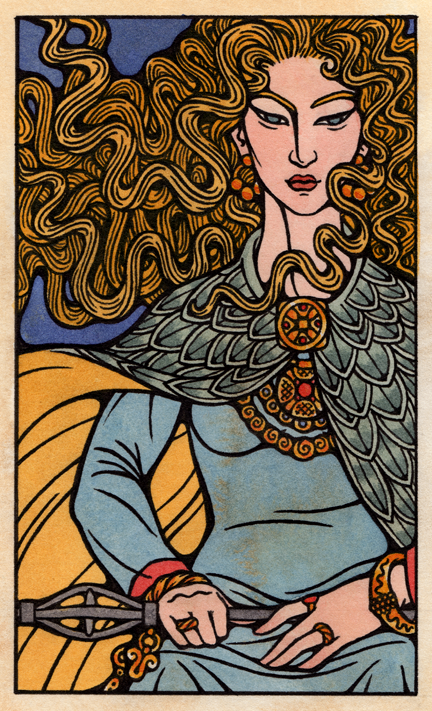

Dea Marica is the Goddess of the Liris River, a slow-moving river
that meanders through Latium (central Italy), and the Goddess of the swamps
and wildlife associated with it. The Liris has its source in the mountainous
territory of the Marsi, not far from Lake Fucinus, and empties into the Tyrrhenian
Sea on the western coast of Italy through a marshy delta. The name Dea Marica
is a descriptive title, not a proper name, meaning "Goddess of the Salt-Marshes"
in the Volscian language (which is related to Oscan) and is a word from the
Aurunci, a tribe whose ancient territory was found between the Liris and Volturnus
rivers (their modern names being the Liri or Garigliano, and the Volturno) in
western central Italy. Her true name does not seem to have come down to us.
Dea Marica's worship was apparently not confined merely to LatiumHer title
was also known among the Ligurians, a tribe of north-western Italy who may have
had Celtic ancestry, and the Piceni, a tribe on the eastern coast of Italy in
the region named for them Picenum. She was also worshipped by the later Romans.
Dea Marica had a sacred grove and a temple at the mouth of the
Liris near the city of Minturnae (modern Minturno). Her grove there was called
the Lucus Maricae (which unsurprisingly translates to "the Grove of Marica");
evidently it was fairly large and thickly wooded (and I'm guessing pretty swampy
too), for it served as a place of hiding and protection for Caius Marius, a
general and six-time consul (kinda-sorta a co-president of Rome) who fled that
city in 88 BCE after using the egregious tactic of bringing armed soldiers into
the forum to force a vote his way. As he had once been a famous general, responsible
for many victories, and as he was also at the time nearly 70 years old, the
people of Minturnae took pity on him and helped him to escape to Africa. It
was said that Dea Marica took him under Her protection while he was hiding out
in Her grove, and that She helped to turn his fortunes for the better.
Dea Marica's temple on the right or north bank of the Liris River
was in the early Italic style, dating probably from the 4th century BCE. The
foundations were found in the 1920's; apparently it had actually been built
in the marsh, for it is described as having been found in "swampy soil".
Many terracotta votive offerings were found there as well, and there is evidence
of use of the site from at least the 6th century BCE.
In Roman legend, Dea Marica was the wife (sometimes mother) of
the God Faunus, an oracular forest God Who was equated with the Greek Pan. She
was the mother of King Latinus, whose daughter was Lavinia, wife of Aeneas,
and so Dea Marica could be considered an ancestress of the Latin, and therefore
Roman, people. Perhaps this is part of why She was associated with the Goddess
Venus (the mother of Aeneas, whose descendants were
to found Rome), though there was also some confusion in imperial times between
Venus's epithet Marina, "of the Sea" and the similarly spelled
Marica. Latinus had ties to Jupiter, and may have been an incarnation
or epithet of His; this could indicate that Dea Marica, as mother of Latinus,
was locally considered an important mother Goddess.
Dea Marica was called "the Enchantress" or "Sorceress"
who was said to be able to turn travellers into animals (though apparently Her
spells could be countered with the herb rue). She was associated with the great
Greek sorceress Kirke, who also had a thing
for changing men into animals, as well as the Witch-Goddess of the Marsi Angitia.
Another connection with Kirke is through the Piceni tribes, mentioned above:
in the (Roman) legend Kirke attempted to seduce the King of Latium who was the
husband of the nymph Canens; when he rejected Her,
She transformed him into a woodpecker, whose Latin name, picus, was both
the name of the King and the sacred bird of the Piceni, who took their name
from it. After Kirke's death it was said She was deified as Marica, much like
the apotheosis experienced by Romulus, who became Quirinus after his death,
or Ino who in the Greek legend became Leucothea.
Not quite 30 miles up the Italian coast from Minturnae was a
promontory called the Circeium, on which was a town of the Volscians called
Circeii, where Kirke (spelled in Latin with C's instead of K's, since they didn't
exist in that language) was said to have once lived. The area was famous both
for its wild boars and its poisonous plants, both of which figure in Her legends:
She was said to have transformed the men of Odysseus's crew into swine, and
She was well known for Her use of poisons and herbs in Her witchcraft.
These associations would make Dea Marica a Goddess of enchantment,
spellcraft, and transformation, as well as a Goddess of the wild woods and salt-marshes
and its abundant wildlife. As a river Goddess and one who knew herbs well, She
may additionally have had a healing and protective function, as evidenced by
the many votive figurines found as offerings at Her temple. Perhaps She even
had some function as a prophetess, both through Her identification with Kirke
(who predicted Odysseus's future travels) and as mother or wife of Faunus, a
prophetic God.
Also called: Marikas, Marica. She was associated with Venus (or
Aphrodite), Kirke (Circe), and Angitia.
