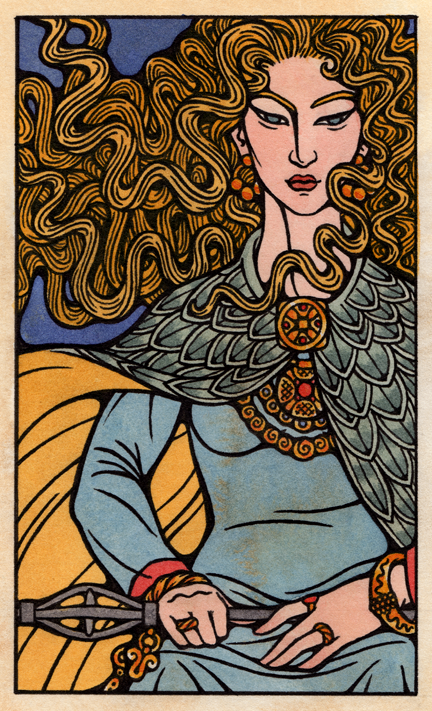

Febris is the Roman Goddess of Fevers, Who can bring or dispell
sickness. She is the fever personified and Her name means just that: "Fever"
or "Attack of Fever". She may have been especially a Goddess of Malaria,
which was notoriously prevalent in ancient Italy, especially in the swampy regions
as the disease is transmitted by mosquito, and She was given offerings by Her
worshippers in the hopes of being cured. The classic symptoms of malaria include
periods of fever, lasting from four to six hours, which come in cycles of every
two to three days, depending on the specific variety of parasite; this would
explain the odd phrase "attack of fever", as it was something that
came and went, and would support Febris's links with that specific disease.
At any rate, malaria was all too common in ancient Rome, and
the Romans knew it; they also had some idea what caused it and how to avoid
itVarro, writing in the first century BCE said that when building a house
or farm "especial care should be taken to place it at the foot of a wooded
hill where it is exposed to health-giving winds. Care should be taken where
there are swamps in the neighbourhood, because certain tiny creatures which
cannot be seen by the eyes breed there. These float through the air and enter
the body by the mouth and nose and cause serious disease"which is
a pretty good guess considering that germs would not actually be seen by the
human eye until some 1700 years later, when the Dutch scientist Antony van Leeuwenhoek
"discovered" bacteria with an early form of microscope (incidentally
he called the little buggers "animalcules"; and if you read his account,
I guarantee you will want to immediately brush your teeth). The Romans
were quite aware of good hygienic practices and incorporated them into their
city planning and public works projects, for example by constructing great sewer
systems to funnel waste away, by draining swamps any chance they got, and of
course by building many many bathhouses.
Malaria was a serious threat to Rome and her peoplerecently
the idea has been floated around that a particularly virulent form of the disease
was a major contribution to the collapse of the Empire. Even today, malaria
is one of the biggest killers of the communicable diseases, second only to tuberculosis,
and there is currently no vaccine. Malaria is particularly deadly to pregnant
women and very young children, and is known to cause stillbirths and miscarriages.
Having healthy children is of course an especial concern of parents (and the
state to some extent), and this probably explains why Febris had three shrines
in Rome. At these shrines She was given offerings of amulets or charms, called
remedia (just like it looks, meaning "remedies", or "cures")
which had been worn by those who had been sick but had recovered.
Her most important shrine or altar was somewhere on the Palatine
Hill; there is no trace of it left and its exact location isn't known. Another
small temple or shrine to Febris was located on the Quirinal Hill, somewhere
near the Baths of Diocletian on the Vicus Longus (literally, "Long Street"),
near its highest point (which I suppose would be furthest away from the swamps).
Her third shrine was located on the Sacra Via, the "Sacred Way", the
oldest street in Rome, which connected the Forum with the Palatine Hill; it
was situated on the slope of the Velia, the small hill between the Palatine
and the Oppius (part of the Esquiline Hill), which would place it squarely between
the Forum proper and the site of the Colosseum. The placement of Her shrine
at that location may be a memory of the formerly swampy and pestilential character
of the Forum valley before its marshes were drained.
Febris's cult was considered to be very ancient, which is not
surprising, as fever and sickness has been around as long as humans have (malaria
is even said to have been a strong influence on human evolution). Febris is
known from inscriptions in other parts of the Empire, so Her cult was not local
to Rome. She is sometimes said to be accompanied by Dea Tertiana and Dea Quartiana,
the Goddesses of (malarial) tertian fever and quartan fever, so-named because
the fever returned every third or fourth day. An inscription to Dea Tertiana
has been found (though since lost) at the fort of Habitancum, in the modern
town of Risingham in northern England, indicating that even in the cooler climates
malaria was common and feared.
Several epithets of Juno are spelled quite similarly to Febris's
name and have caused some confusion, to the point where the month of February
was supposed to have gotten its name from the "fevers of love" which
were explained as being peculiar to that month for some reason. These namesFebrua,
Februlis, Februata, or Februalis were epithets of Juno as a childbirth Goddess
Who delivers the afterbirth and then purifies the new mother; the name is related
to februalis, "religious purification" and not to Febris's
name.
Also called: Dea Febris
