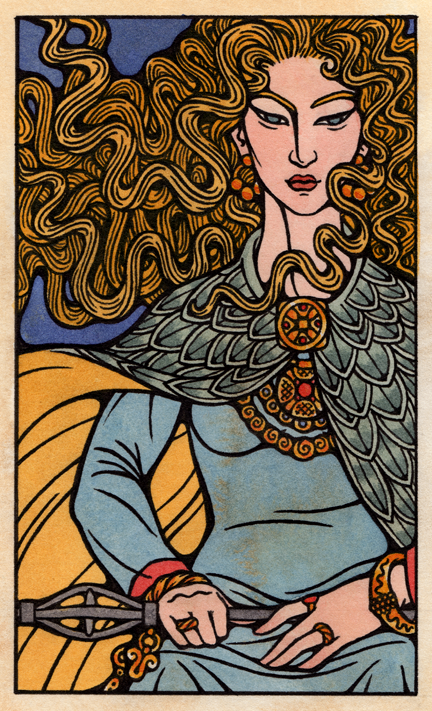

Ferentina is an ancient Latin Water and Fertility Goddess of
the spring named after Her the Aqua Ferentina, located in the woods near Castrimoenium,
the modern Marino, Italy, on the edge of Lake Albano (Latin Lacus Albanus),
a large spring-fed lake rather dramatically located in the crater of an extinct
volcano. She is said to have been the patron Goddess of the town called Ferentinum,
a city of the Hernici (a Sabine tribe), about 45 miles south-east of Rome, off
the via Latina; but it is likely the ancients confused this town with the site
of Her spring and grove, which may very well have been known locally as Ferentinum
after Her. The Hernician Ferentinum, now called Ferentino, is located about
30 miles from Her spring at Castrimoenium. It was originally a city of the Volscians,
who were of Umbrian or Oscan origins, but it was later inhabited by the Hernici,
a Sabine tribe. The town-name Ferentinum is likely derived from a reconstructed
Umbrian stem *fer- meaning "to bear" or "to carry";
in Latin, which is closely related, we get the verb fero, "to bring"
or "to produce", from which comes the word ferax, "fruitful"
or "fertile". (These words are all related to the English word "bear",
as in "to bear young", as well as the word "birth" itself.)
According to that, Ferentinum would then mean "the place that is
fertile"; if the town-name and Goddess-name share a root (which seems not
unlikely) then Her name would mean "She Who Is Fruitful", or "She
Who Bears Young". (There is another Latin word, ferentarius, meaning
"lightly armed soldier"; I rather doubt it is related. In the stem
form it is ferentari; stick an accent on it and you'd get Ferentári,
a perfectly good Quenya word meaning "Beech Queen", probably an obscure
title of Melian or something. Anyhowdyhoo)
Hernician Ferentinum was known in ancient times as being a quiet
country town, where one could escape the bustle and noise of the city. There
were additionally other cities in Italy with suspiciously similar names, such
as Ferentana, located in Samnium, and Ferentum, a town in Apulia. Both Apulia
and Samnium were regions of ancient Italy located on the eastern (Adriatic)
coast; they bordered each other, and Samnium was a neighbor of Latium, the region
in which Rome, Lake Albano, Ferentinum, and Castrimoenium were located. I don't
know if these cities were named for Ferentinathey may simply share a common
description as places with fertile soilbut as they were neighboring territories
it is not impossible that Her worship was known among the people there. (There
was also a Ferentinum of Etruria, the modern Ferenti, but as it is an Etruscan
name it would seem to have nothing to do with Ferentina, since Etruscan is a
language all its own and not of Indo-European origin.)
Ferentina's spring was located in a sacred grove in a densely
wooded valley, and a section of forest in Marino is still called the wood of
Ferentina. What is assumed to be Her spring is currently found in a small park
called the Parco di Colonna; it still flows quite copiously and gives rise to
a brook called the Marrana del Pantano; evidentally the stream has carved out
a boggy ditch, going by the name (which as far as I can tell, and I don't speak
Italian, means the "steep-banked brook of the morass", unless Pantano
is simply a name). The area around this spring has been inhabited since pre-Roman
times, and there is evidence that the local people established trade with the
Etruscans to the north. At this grove Ferentina also had a shrine, which was
famed as the meeting place of the Latin League, a confederation of cities of
Latium in the early days of Rome. The Latin League met there regularly until
the mid-4th century BCE; about that time the cities of Latium, which had long
been at odds with Rome, were defeated by that city and absorbed, amoeba-like,
into its ever-expanding territory. There were traditionally 30 member-cities
of the Latin League, and one imagines the shrine and/or meeting place must have
been of a good size; in modern times there were said to have been Roman ruins
near Her fountain, though there is little left today.
Tarquin the Proud, traditionally the last King of Rome before
the Republic (and son-in-law of Servius Tullius, the guy who built all those
temples to Fortuna) was said to have framed the Latin
leader Turnus Herdonius, who had spoken against him; while the Latins were all
assembled at the shrine to Ferentina, Tarquin made it seem that Turnus had plotted
against the other Latins as well as himself by smuggling a whole bunch of weapons
into Turnus' home, making it appear that Turnus was getting ready for a murderous
spree. The Latins, who didn't much like Turnus anyway, were all too ready to
believe Tarquin, and upon finding the weapons were so angry that they would
not even hear his defense, and had him immediately executed by drowning him
in Ferentina's spring.
In another Roman tradition of the early days, set down by Plutarch
(who lived in the 1st-2nd century CE), Rome was said to have been visited by
a plague because Romulus, the very first King, had not sought justice in the
murder of Titus Tatius, the former King of the Sabines, who for a time had ruled
Rome jointly with Romulus. He was finally persuaded to perform the necessary
rites of purification, and the plague abated. Plutarch then says that these
rites were still being performed at the grove of Ferentina in his time.
Ferentina had another cult center at the city of Aricia, located
sort of between Lake Albano and Lake Nemi (aka Nemorensis), another, smaller,
lake-in-a-volcanic-crater only a few miles from Lake Albano. The famous grove
of Diana Nemorensis was located there, in which
grew a "golden bough" in a sacred oak, probably mistletoe, and which
featured in the ritual by which Her priests were replaced. The name Aricia may
be linked to the Latin verb arare "to plow"; if so, its name
would mean "place of arable land", which is not dissimilar to the
meaning of Ferentinum ("place that is fertile"); perhaps Ferentina
as a Goddess of fruitfulness has something to do with the name; perhaps it's
just that the soil around volcanoes is especially fertile.
Though little is said or known about Ferentina Herself, Her attributes
can be pieced together from the stories told of Her holy places. She is, of
course, a Goddess of Water and Springs, specifically the Nymph of a spring central
to the Latin peoples; and springs are traditionally symbolic of origins, birth,
and connections with the Underworld, as they emerge directly from underground.
She is a Goddess of the Earth and the powers of fertility, fruitfulness and
birth; and She is especially associated with land good for farming, and by extension
the civilizing powers of agriculture, much like Ceres.
She watches over Her people, the Latins, and protects Her patron cities. But
there are also hints of a darker side to Her, in the association of both springs
and the dark earth with the Land of the Dead; and two of the tales mentioning
Her grove involve murders. In Turnus's murder the Latins make doubly sure he
is gone by sending him straight to the Underworld not only through his death,
but by the medium of a spring, considered a gate to the Underworld as well as
a proper place to send sacrifices to the Gods; and the traditional purificatory
rituals performed at Her grove are also linked to the murder of a leader or
King. One could, I suppose, also infer a veiled reference to the idea, common
in myth, that the King, like the year, dies or is killed annually, to be replaced
with a younger, stronger, more virile version; if that holds (and I suspect
it is the proximity of the grove of Diana Nemorensis to Ferentina's that put
it in my head) then perhaps Ferentina is a Goddess of the process by which the
end and the beginning of a cycle are smoothly joined, in the recognition, that
though necessary or even proper to the general well-being, the King's death
is a disruption still, and that right order must be restored through the proper
rituals.
