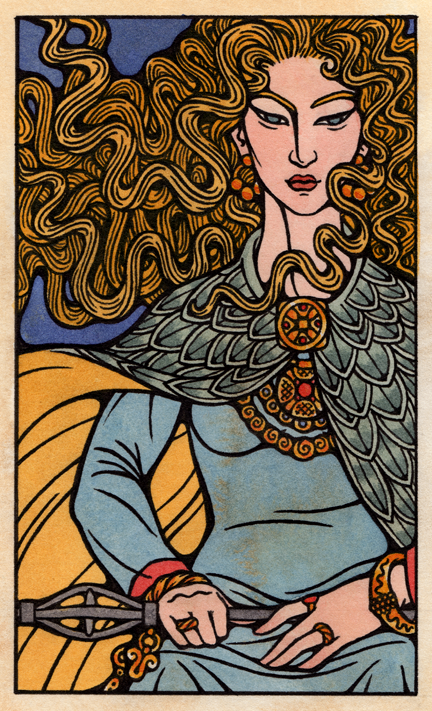

Fortuna is the Roman Goddess of Luck, Fate, and Fortune, as Her
name implies. She was a very popular Goddess, and was worshipped under many
epithets depending on the type of luck one wished to invoke or the circumstances
in play. She had many temples in Rome itself, as well as having important cult-centers
in Antium (the modern Anzio), a city on the west coast of Italy about 30 miles
south of Rome, and Praeneste (modern Palestrina), about 20 miles south-east
of Rome, both of which were cities of Latium, the land of the Latini tribes.
Her many temples in Rome, and the various aspects of Her worship are a reflection
of the manners in which She was honored: from personal Goddess, overseeing the
fate of the individual mother, young man, or soldier, to a Goddess of the State,
ensuring the fortune of the populace, the luck of the Emperor, or the glorious
fate of the entire Roman Empire.
Fortuna was usually depicted holding in one hand a cornucopia,
or a horn of plenty, from which all good things flowed in abundance, representing
Her ability to bestow prosperity; in the other She generally has a ship's rudder,
to indicate that She is the one who controls how lives and fates are steered.
She could also be shown enthroned, with the same attributes of rudder and cornucopia,
but with a small wheel built into the chair, representing the cycles of fate
and the ups and downs of fortune. Sometimes She is blind, as an acknowledgment
that good luck does not always come to those who seem to most deserve it; at
other times She is described as having wings, much like many Etruscan Goddessesand
indeed She was equated with the old Etruscan Fate Goddess Nortia,
who was often shown winged.
The name Fortuna finds its root in the Latin fero, meaning
"to bring, win, receive, or get". She may have originally been a Goddess
of Fertility, Who brought prosperity and success in the form of abundant harvests
and offspring. Her worship in Rome traditionally goes back to the time of Ancus
Martius, the 4th King of Rome, who is said to have reigned from 640-616 BCE.
According to the propaganda of the time (and the Romans invented an awful lot
of it to make it seem that their city had always been destined for greatness,
and wasn't just some upstart town founded by a bunch of sheep herders on some
hills surrounded by malaria-infested swampland, which it was), when Fortuna
first came to Rome, She immediately threw off Her shoes and discarded Her wings,
announcing that She'd found Her true home and intended to never leave it.
Alternatively, Fortuna's name may derive from that of the Etruscan
Goddess Veltha or Voltumna, whose name encompasses
ideas of turning and the alternating seasons. Voltumna in turn may be related
to the Roman Goddess Volumna, Who watched over and
protected children; and both of these themes are found with Fortuna, who was
often depicted with a wheel, and who was said to predict the fates of children
at their births. As a Goddess of Fate Fortuna naturally had the power to foretell
the future; and under Her aspect of Fortuna Primigenia
in Praeneste She had an oracle, in which tablets inscribed with messages were
chosen from a jar. She also had an oracular shrine at Her cult-center in Antium.
Fortuna had a very old temple in Rome on a hill between the Forum
Romanum (the Roman Forum) and the Forum Boarium (supposedly the old cattle-market),
near to the temple of Mater Matuta. Both temples
had the same dedication day, the 10th of June, and each had a horseshoe-shaped
altar before it of the earliest type. Fortuna's temple had a very old statue
of gilded wood inside, also of an archaic type; and the altar and statue indicate
that Her worship dates at least to the earliest days of Rome, if She is not
an earlier Goddess of the Latins.
The Emperor Trajan (97-117 CE) dedicated a temple to Fortuna,
at which offerings were made to the Goddess on the 1st day of January, at the
start of the New Year, probably to ensure good luck and success for the coming
year. This temple was dedicated to Fortuna in all of Her aspects.
With Greek influence, Fortuna was equated to Tykhe, their Goddess
of Luck and Fortune. Under the title Dame Fortune, Fortuna never lost Her power
as an allegorical figureShe makes an appearance on card 10 of the Tarot
Major Arcana, the Wheel of Fortune, and She is still to some extent honored
today, for She features in gamblers' prayers to "Lady Luck".
She is associated with the Goddess Felicitas,
the personification of happiness, and Spes, the Goddess
of Hope.
As mentioned above, Fortuna had quite a few aspects, many of
which had their own holidays and centers of worship; I treat them here separately:
Fors Fortuna, Fortuna
Antiat, Fortuna of Antium, Fortuna
Aucupium, Fortuna Augusta, Fortuna
Balnearis, Fortuna Barbata, Fortuna
Bona, Fortuna Brevis, Fortuna
Conservatrix, Fortuna Dubia, Fortuna
Equestris, Fortuna Felix, Fortuna
Gubernans, Fortuna Huiusce Diei, Fortuna
Liberum, Fortuna Mala, Fortuna
Mammosa, Fortuna Manens, Fortuna
Mobilis, Fortuna Muliebris, Fortuna
Navirilis, Fortuna Obsequens, Fortuna
Patricia, Fortuna Plebis, Fortuna
of Praeneste, Fortuna Primagenia, Fortuna
Privata, Fortuna Publica, Fortuna
Redux, Fortuna Respiciens, Fortuna
Restitutrix, Fortuna Romana, Fortuna
Salutaris, Fortuna Tranquilla, Fortuna
Virginalis, Fortuna Virgo, Fortuna
Virilis, Fortuna Viscata, Sorores
Antii.
