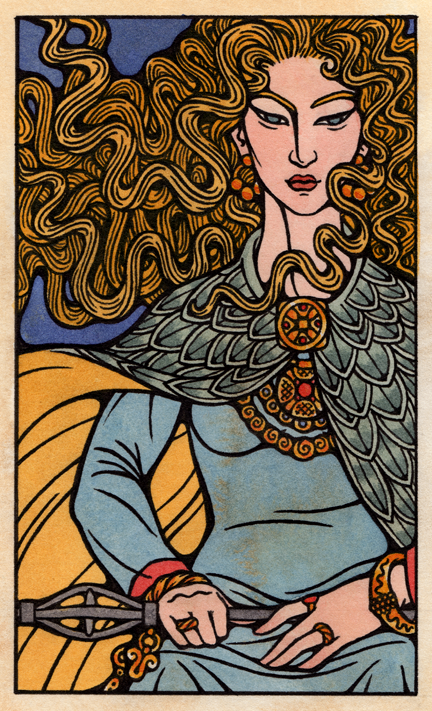

Fulgora is a Roman Goddess of Lightning, which is exactly what
Her names means in Latin: "Lightning," "Flashing," or "Brightness."
There is not much in the source material on Her, and I could
find no evidence of rites, worship, temples, or altars that were specific to
Her. The only mention of Fulgora by name that I could find in classical texts
was in Saint Augustine's City of God, where he quotes the Roman rhetorician
(orator) Seneca, from a work presumably lost to us.
Augustine, who lived in the fourth and fifth centuries of the
common era, was a North African Pagan (a Berber from Algeria, to be precise)
who later converted to Christianity (after saying goodbye to his companion of
thirteen years, a concubine he calls simply "The One"). He eventually
rose to become bishop of Hippo Regius in Algeria (the modern city of Annaba),
and during that time wrote the book mentioned above, whose full title is The
City of God Against the Pagans, which title is a clue to his attitude towards
Pagan religions, by which he meant that of the Romans. Mostly the book is a
defense against the charge, then in vogue, that the downfall of the Roman Empire
was attributable to the rise of the Church; much the same charge has been levelled
in modern times (for example in the question, What made the Dark Ages dark?
The answer to which is: Christianity, with its condemnation of the learning
of the ancients) and I can't help but think the ancient Pagans had a point.
Be that as it may, Augustine comes across as rather a prissy jerk in the book
(well, to me, anyway), for he goes to great length to mock the old Gods, especially
the minor or small ones, Whom he compares disfavourably to his One God, Who,
he thinks, is obviously better, since there only needs to be one of Him.
Now, given that Christianity is still with us, whereas the Roman
tradition has had to be revived and did not survive in an unbroken line, Augustine's
work has survived; and many of the names of some of the minor Roman Goddesses
and Gods are known only through his work, since he goes to such great lengths
to mock every last one he can think of. I suppose we should be grateful to him,
then: for his mockery has actually ironically assured Their immortality. The
joke's on who, again?
Anyway. So in this passage, Augustine quotes Seneca, who lived
a good four centuries earlier, right around the time of the BC/BCE switch. He
says Seneca says:
We marry Bellona to Mars, Venus to Vulcan, Salacia to Neptune.
Some of them we leave unmarried, as though there were no match for them, which
is surely needless, especially when there are certain unmarried goddesses, as
Populonia, or Fulgora, or the goddess Rumina, for whom I am not astonished that
suitors have been awanting.
Now, I've no idea why the idea that some Goddesses were unmarried
in the mythology should be so shocking, nor can I account for Seneca's sarcasm,
but apparently he considers Populonia,
Fulgora, and Rumina
not of marriagable material. Oddly enough, both Populonia and Rumina are considered
aspects of Juno, Who
are especially concerned with fertility and motherhood; perhaps he is objecting
to the idea of unmarried mothers, I don't know. Though given that grouping I
find myself wondering, probably without reason, if Fulgora likewise might have
something to do with Juno; Juno was, after all, one of the special class of
Deities Who had the ability to throw thunderbolts.
The lack of mention of Fulgora, or evidence of temples or rituals
to Her is a little surprising, given the Roman interest in the phenomenon of
lightning, which they considered an especially important portent. Perhaps She
is simply lightning personified (though the noun fulgura itself is neutral,
not feminine).
The Roman fascination with lightning was inherited from the Etruscans,
who had books devoted to the practice of haruspicy, or divining the will
of the Gods, said to have been invented by Tarkhies (Latin Tages), the Etruscan
God of Wisdom Who was born from the Earth. Nowadays haruspices are mostly
remembered for predicting the future by the shape of sheep's entrails (especially
the liver); but reading lightning was another of their specialities, and the
Etruscan books concerning the art were called the Libri fulgurales, or
"books about lightning-omens." In a more official capacity, the augurs,
a college of priests concerned with making sure the state was doing things in
line with the will of the Gods, also read the signs, including lightning.
As an omen, lightning was considered an auspicia oblativa,
an unsought auspice, meaning one out of the blue and not officially requested
through ritual. Lightning and thunder were of a class of omens called ex
caelo ("from the heavens") and were the most important type; and
if an augur officially reported thunder or lightning, the comitia
(officially assemblies) were not to be held.
Lightning was recognized as several different types, which affected
the interpretation of the sign: there were for example types considered "punishing",
"ominous," "decisive," or "boastful." Pliny the
Elder, who lived in the first century CE (and who died in the famous eruption
of Mount Vesuvius) says in his Natural History that according to the
Etruscans there are nine Gods who have the ability to send lightning, but eleven
types of lightning, since Jupiter throws three kinds. (Though he also says that
the Romans only recognize two Gods who sent lightning: Jupiter in the daytime,
and Summanus or Pluto at night.) We know of at least seven Gods who were thought
to throw thunderbolts: Jupiter, Juno, Mulcibar/Vulcan, Minerva, Mars, Saturn,
and Summanus/Pluto (though besides Pliny I haven't found anything linking Summanus
and Pluto, so perhaps they are to be considered separately).
In the Etruscan system the sky was divided into four parts, with
four smaller subdivisions; lightning seen in the eastern part of the sky was
considered lucky or favorable, while that from the northwest quadrant was thought
especially terrible and unfortunate. Pliny also says that only lightning that
comes without thunder or noise is properly a sign from the Gods. He then makes
the astonishing statement that lightning could be conjured from the sky by humans,
if the proper rituals were observed; and that he knew of groves and altars set
aside for that purpose. (Don't try this at home, I feel I should warn.)
A place that had been struck by lightning was called a bidental,
and was considered sacred to Jupiter. It was marked off and made separate, neither
to be walked on nor even looked at, and a two-year-old sheep was traditionally
sacrificed. A bidental was often given an altar, and a structure called
a puteal, or "well-head" (which was usually used for just that,
wells or springs) was used to cover the spot. The name is a little mysterious,
though: it is derived from bidens "two teeth" and may refer
to either the young sheep sacrificed, or to the forked appearance of lightning.
All this Roman fascination with lightningwhat it might
mean as message from the Gods, and the proper respect and rituals around places
it has struckmakes it all the more odd that we have just a single mention
of Fulgora. That Fulgora protected Her devotees from lightning is a not unreasonable
supposition based on Her name. The practice of burying stone axes thought to
represent thunderbolts at Roman sites has been taken as an attempt to prevent
lightning strikes. It would make sense that Fulgora had a part in these practices,
or was invoked in the sacrifices at a bidental, but we don't really know.
