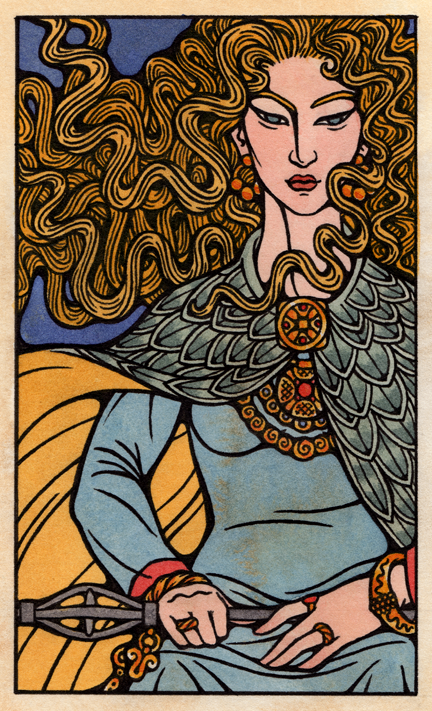

Furrina is an ancient Roman Goddess Who may have Etruscan origins.
Her exact nature is debated; however Her worship is quite old, dating from very
early times, though by the end of the Roman Republic Her cult was almost forgotten.
She had a sacred grove located on the Janiculum, a long ridge or hill on the
right bank of the Tiber in Rome; Her grove evidentally had a spring, and probably
had a shrine there as well. In later times (the mid-1st century CE) a temple
to the Syrian Triad of Jupiter Heliopolitanus (the Roman version of the Phoenician
Storm God Ba'al-Hadad), Venus Heliopolitana (the Syrian Goddess Atargatis)
and Mercury (considered Her son, possibly Simios) was built on the site, and
perhaps because of this there have been few remains found there from Republican
times.
Furrina was important enough once to have merited a festival,
called the Furrinalia (or the Furinales feriae, literally "festival
of Furrina"), which was held on the 25th of July, though nothing besides
the name is known of Her holiday. She also had Her own priest, the flamen
Furinalis (flamens being one of 15 priests each dedicated to the cult of
a particular Deity); other Goddesses served by flamens include Flora,
Pomona, Carmenta
and Ceres. The obscurity of Furrina, as well
as that of some of the other Deities who had flamens, such as Falacer (Who was
probably some sort of hero) and Volturnus (a River or Wind God, sometimes called
the father of Juturna), may indicate that these cults,
and the worship of their Gods, are pre-Republic in origin.
Furrina's name has been used to connect Her to robbers or thieves,
and to the Roman Goddess of Thieves Laverna.
Her name is quite similar to certain Latin words relating to that idea, though
if Her origins are Etruscan, it wouldn't seem likely that Her name is related,
as the Etruscan language is in a family all its own and is not connected with
Latin, nor is it an Indo-European language (though that would not prevent it
from being a loan-word or translation, I suppose). At any rate, the similar
Latin words are furina, "thief", or "robber"; furtum,
"theft"; furtim, "stealthily"; and furax,
"thievish" (these words are also at the root of the English furtive,
meaning "stealthy" or "thief-like"). Accordingly, some authorities
consider Her a Goddess of Thieves or Bandits, much like Laverna. These Latin
words, oddly enough, are also related to terms pertaining to bees and bee-keeping;
furina can also be used of "robber bees", or bees who steal
honey from colonies not their own, usually if there is insufficient nectar to
be found out in the fields at the time; and forina (an alternate spelling
of Furrina) can refer to a cell of bees. What Furrina might have to do with
bees, however, is not known.
An alternate theory to the origins of Furrina's name is that
it is related to the Latin furvus, meaning "dark" or "black",
or to fuscus, "dark" or "dusky", which are taken
to refer to an aspect of Furrina as a dark Goddess.
Some ancient authorities considered Furrina an Underworld or
Death Goddess, possibly through confusion of Her name with the Furies, the Roman
name for the avenging spirits whom the Greeks called the Erinyes. Their name,
though, comes from the Latin verb furo, "to rage" (which gives
us "furious"), referring to Their bad tempers, and is probably not
related to Furrina's. However, the cult-site of Jupiter Heliopolitanus, which
was built within the lucus Furinae in later times (as mentioned above),
did have Underworld connections; several graves have been found at the site
as part of the temple complex, and beneath the altar to Jupiter there the top
half of a human skull was found, apparently as some sort of offering. That it
was considered religiously appropriate to build His temple on the site of Furrina's
sacred space does seem to indicate some sort of religious affiliation between
the two cults, for the Romans were sticklers for proper ritual, and paid especial
attention to the traditions associated with sacred locations. The location of
Her grove or sacred site on the Janiculum also fits with an Underworld or Death-Goddess
attribution, as the Janiculum was considered ritually "outside" of
the city proper as it was beyond the pomerium or sacred boundary of the
city; inside the pomerium, which was marked out according to ancient
Etruscan practices, cemeteries and burials were forbidden. It was also thought
improper to hold military or war activies within the pomerium, perhaps
due to the violent or death-aspects of war; and the temple to Bellona,
the Roman War-Goddess, was located outside of it.
Furrina was thought by Plutarch to be a Spring or Water Goddess,
and he calls Her a nymph; a spring was found within the temenos (sacred
enclosure or courtyard) of the temple of Jupiter Heliopolitanus, which may have
originally been Furrina's (though there is another well on the site that appears
to be older that may have been Hers). In late times the nymphae furrinae
and the Forinae are mentioned; whether these refer to a plurality of Spring-Goddesses
called Furrina (much like Sulis, Goddess of the hot
springs at Bath, England, was sometimes named in the plural), or simply to Spring-Goddesses
associated with the location of Furrina's grove is not clear.
Her grove on the Janiculum was the site of the death of Gaius
Gracchus, the younger half of the famous Gracchus brothers (of whom their mother
was justly proud), both of whom were elected tribune in the late 2nd century
BCE. Gaius was famous for having instituted the annona,
or distribution of wheat to the poor of Rome; he lost his reelection bid in
121 BCE, though, because of opposition to his proposal to grant Roman citizenship
to the Latins and other Italians. Due to the political machinations of his enemies
his former popularity soon waned and he found himself on the pitchfork-end of
an angry mob, who chased him out of Rome; and in the grove of Furrina he was
put to death by his slave, Philocrates, at his own request.
Furrina's cult was not only known in Rome; She was said to have
had a temple or shrine in the city of Satricum on the Liris River, not far from
Arpinum in Latium, about 65 miles south east of Rome. Arpinum (the modern Arpino)
is a very old city, dating from at least the 7th century BCE and said to have
been founded by the Volscians; the Satricum on the Liris is not the same as
the more famous Satricum destroyed by the Romans, which was, like Arpinium,
a Volscian town. Perhaps these tenuous associations hint at a Volscian origin
for Furrina; perhaps not. Who knows?
Despite the reallocation of Her grove to Jupiter Heliopolitanus,
Furrina's worship, or at least Her presence at the site, was not forgotten by
all, for a late inscription to Jupiter Heliopolitanus mentions the genius
or (male) guardian spirit of the site, the genius Forinarum ("Spirit
of Furrina" or "Spirit of [the Grove of] Furrina").
Alternate spellings: Furina, Forina; in the plural, the Forinae.
