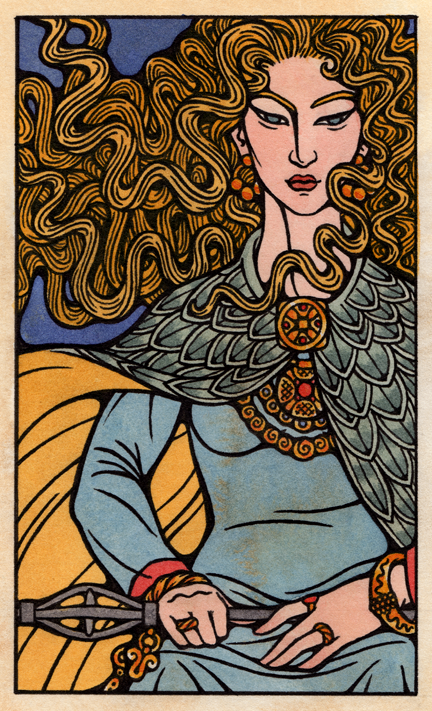

Laetitia is the Roman Goddess of Joy, Gaiety, and Celebration,
and is especially linked with holidays and festivals. Like many Goddesses Who
were personified ideas, Laetitia seems to have been a late addition to the Roman
pantheon, and was often found on coins of the Empire, used for propaganda purposes
to boost the image of the Emperor or his family. Her name means "Delight",
"Happiness", or "Joy", and could additionally be defined
as the "Fruitfulness" or "Fertility" assumed to be the foundation
of that happiness. Her name is related to the Latin word laetus, which
has a whole cluster of meanings connecting happiness with prosperity and abundance:
it can mean "happy", "glad", "lucky", "successful",
"prosperous", "luxurious", "lush", or "abounding";
and it was used to describe fertile land.
Laetitia is depicted on the coins of several Emperors of the
2nd and 3rd centuries CE, and can bear a variety of attributes; She is often
shown holding or wearing a wreath or garland as a symbol of celebration, since
wreaths of flowers or leaves were commonly worn during festivities or holy rituals.
Likewise She can be shown with a branch of greenery, as they were used for some
holiday decorations (much like we "deck the halls with boughs of holly"
for Christmas or Yulewhich tradition, incidentally, owes a lot to the
Roman Saturnalia). She may carry symbols of fertility
and prosperity such as apples or a handful of wheat sheaves; or symbols of power
such as a sceptre or spear; She was sometimes shown with an anchor, as a representation
of stability, or, like Fortuna, a ship's rudder symbolizing
guiding fortune or the actions chosen to steer one towards prosperity.
Laetitia was given several epithets depending on the type of
joy the Emperor was attempting to take credit for bringing to the Empire. On
coins of the Emperors Gordian III and Gallienus, who both reigned in the mid
3rd century CE, She is Laetitia Augusta, "the Joy of the Emperor",
which, in propaganda-style, can be taken to mean "the joy the Emperor brings
to the people", though it may also have been a way of announcing the birth
of a child into the imperial family. On these She is shown standing in Her typical
pose, with a garland in one hand and an anchor supporting the other; other coins
labelled Laetitia Augusta depict a ship with the Emperor himself steering it,
reinforcing the idea of the Emperor as the one who brings happiness to the people
of the Empire, though it likely also refers to the idea of prosperity through
naval conquest and the control of the resources of the conquered.
She could be known as Laetitia Fundata, "Established"
or "Well-Founded" Joy; these coins usually show Her with a ship's
rudder, often resting on a globe. Again, these depictions hammer home the idea
that the foundation of the Empire's happiness was built on its ability to dominate
and direct the course of events, though they may also, more practically, make
reference to the Empire's dependence on imported grain to keep its people fed.
As Laetitia Fundata She was featured on coins of the Empress Crispina, the wife
of the notorious Commodus (who you may remember from the movie Gladiator;
he was killed by Russell Crowe) and of the Emperor Philip I; one wonders though
if the wishes for a secure and stable variety of joy were a result of their
own insecure timesfor Philip I was killed in battle alongside his son
Philip II, and Crispina, well, she was banished from Rome, only to be murdered.
(Ten years later, of course, Commodus himselfon whom my otherwise comprehensive
Classical Handbook wastes a single line, calling him "the worthless
son of Marcus Aurelius"was murdered, on the very last day of the
year 192 CE. Felix sit annus novus, indeed!)
On a coin of the Emperor Antoninus Pius, who ruled 138-161 CE,
the inscription on the back side refers to Laetitia and to his 4th consulship
(a consul being roughly a co-president of Rome, an office which, in the
oh-so-democratic world of the Roman Empire, could be held by the Emperor at
the same time he was Emperoryeah, real big on the separation of powers
there); though its hard to say if it refers to the Goddess of Joy or just joy
as a concept since She is not depicted on it; rather the Grain-Goddess Ceres
is shown with Her daughter Proserpina (perhaps better known by their Greek equivalents
Demeter and Kore or Persephone). Ceres holds wheat
sheaves while Proserpina holds a pomegranate; though both are proper to those
Goddesses, they are also similar to Laetitia's attributes of fruit and wheat
as symbols of fertility and prosperity. In the case of Antoninus Pius, the mother-daughter
divine pair probably makes reference to his devotion to the Emperor Hadrian
(hence the "Pius" surname), who had adopted Antoninus as his heir.
The Joy-Goddess also made appearances on coins as Laetitia Publicae,
"the Joy of the People" or "the Common Joy", again implying
that the Emperor is the cause for the populace's (hopefully) current prosperity.
As other depictions She holds several ears of wheat in Her right hand; but in
Her left She holds the hasta pura, literally a "blameless spear",
a special type of small spear missing the iron blade which was given as a military
award, generally to a soldier who had saved another's life. As a symbol of divine
power the hasta pura was also carried by the Goddesses Pax
("Peace") and Providentia ("Providence"
or "Foresight"), perhaps to indicate righteous victory, or the peace
and prosperity that can flourish when a war is won.
And lastly, She was on some coins called Laetitia Temporum ("Celebration
of the [special, rare] Occasion"); these coins, too, did not generally
show the Goddess Herself, but had an image of a boat surrounded by wild animals.
This referred to the great public spectacles of the ludi saeculares,
or the Saecular Games, so-called because there were supposed to be held once
in a saeculum, meaning an "age" or a "century", making
them literally "once in a lifetime", though unsurprisingly they weren't
held with quite that regularity. The ship surrounded by animals may represent
the importation of exotic animals to be killed for sport in an amphitheatre,
or it may be a depiction of a mock "battle" with the said doomed animals.
These ludi saeculares were primarily dedicated to the King and Queen
of the Underworld, Dis and the above-mentioned Proserpina, in thanks for or
in the hope of averting plague; and their importance and extravagant nature
were due to being established to assure the future health and continuity of
the Roman people. According to one tradition they were founded in gratitude
when a disease afflicting children was lifted; another says they were first
held to appease the angry Underworld Deities, who had sent a terrible plague
which caused every unborn child to die in the womb. Historically the ludi
saeculares were reserved for when dire emergencies threatened Rome, though
the Emperor Philip I held them in 248 CE to mark the millennial celebration
of the city.
As was appropriate to a celebration on such a grand scale, many
of the Gods of the Roman pantheon were invoked at the games; and though Laetitia
is not referred to by name, Her mention on the coins minted to commemorate the
event does seem to imply that She was considered some sort of patron Deity of
the games, or was at least thought to be the personification of celebration
on such a grand scale. And as the ludi saeculares were specifically concerned
with the fertility of women and the birth rate, Laetitia's connections with
fruitfulness as well as happiness would be quite appropriate. It is interesting
to note, also, that the festivities of the ludi saeculares were in reaction
to a real and very dark fear, much as midwinter festivals like Yule and Christmas
are based in the hopes of light driving away the dark; perhaps Laetitia then
more accurately represents the ability to celebrate and be joyous in spite of
one's fears.
Laetitia, or more accurately, a "groundless" version
of Her is mentioned by Ovid in his Metamorphoses as being a friend of
the Rumor-Goddess Fama; in this case, Laetitia represents
the unfounded joy gossip can quickly bring and just as quickly dash.
