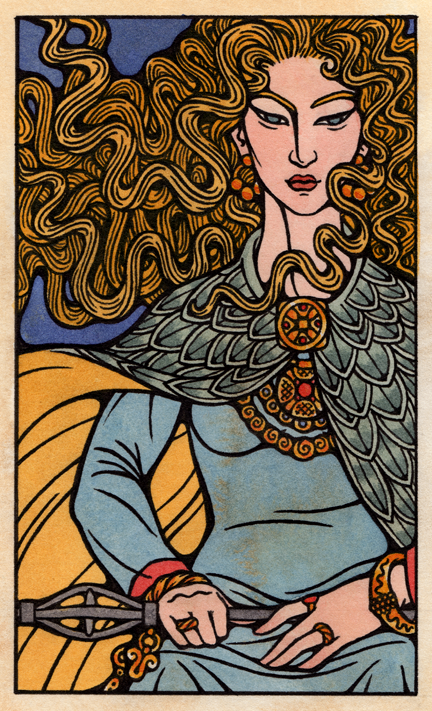

Menrfa, or Menrva, is the Etruscan name of the Goddess of Wisdom
and the Arts, who in Rome would be known as Minerva,
and who corresponds to the Greek Athene. She
is the Goddess of the mind, of crafts, artisans and trade guilds, and did not
have a martial character until She was identified with Athene, who was brought
to south-western Italy by Greek settlers. She was worshipped by workers and
craftspeople, and was the patroness of the arts and learning, of engraving,
weaving, painting, sculpture, dyeing, spinning, and teachers and students.
Menrfa could be considered a Goddess of Healing as well. Her
temple in Veii, the famous Portonaccio temple, contained three cella or chambers,
implying a triad of Deities were worshipped there, probably Menrfa, Turan,
and Artimi (Artemis) or Aplu (Apollo).
Excavations there have found a basin that had been piped to receive the local
sulphurous water, a type of water often considered to have healing properties;
and votive offerings in the form of terracotta body parts, commonly given by
people seeking healing of those parts, were also found. It is thought that some
part of the worship at Her temple in Veii included the giving of oracles; whether
these were attributed to Menrfa or to one of the other Deities there (for example
Aplu/Apollo, who was the patron God at the Oracle at Delphi in Greece) is not
known.
The name Menrfa is cognate to the Latin Minerva, which finds
its roots in the Latin mens, or "mind, reason, intellect".
There has been long debate on whether "Menrfa" derives from Latin
also, or if it is in fact of Etruscan origins, borrowed into Latin (for though
Latin and Etruscan are not related languages, they were certainly close enough
geographically to borrow and loan words now and again). However, within the
area of Etruria were a tribe of people called the Faliscans, whose capitol city
of Falerii (the modern Cività Castellana) was a cult-center of Menrfa.
The Faliscans spoke a dialect closely related to Latin, though they were Etruscan
enough that Falerii was considered one of the twelve cities of the Etruscan
federation, and so my guess is that "Menrfa" is a Faliscan word, that
looks Latin because Faliscan is so closely related. When Falerii was captured
by Rome in 241 BCE, the worship of their Menrfa was brought to Rome as Minerva
Capta ("Minerva the Captive", probably referring to the physical transfer
of Her cult-statue to Rome). Though this event was traditionally held to mark
the beginning of Minerva's worship in Rome, this is unlikelysince Menrfa
was one of the major Etruscan Goddesses, said to have a temple in every Etruscan
city, one would guess Rome had heard of Her before. Besides which, Her temple
on the Aventine Hill in Rome most likely pre-dates the capture of Falerii.
Menrfa was one of the three main Etruscan Deities, with Uni
and Tinia, the Earth Mother and Sky Father, who would later be known as the
Capitoline triad of Juno, Jupiter, and Minerva, so named because of a temple
with three chambers that They shared on the Capitoline Hill in Rome. The three
of them had the power to wield thunderbolts, considered major portents by the
Etruscans and the Romans.
Menrfa was usually depicted much like Athene was in a long chiton
and helmet, carrying a spear and shield, with one major difference: like many
Etruscan Deities, Menrfa was often given wings. Since the Etruscans had from
early times had contact with the Greeks their Menrfa bore attributes of Athene
almost from the get-go, and it is difficult to tell what Menrfa was originally
like before Greek influence set in. There are, however, some depictions that
show Her in Her civilian clothes, as it were: generally these depict scenes
from the Judgment of Paris, a Greek tale in which the hero Paris or Alexandros
is compelled to choose which of three Goddesses is the most beautiful: between
Hera, Athene
and Aphrodite (the Etruscan Uni, Menrfa
and Turan), he chooses Aphrodite, and the resulting bad blood (not to mention
his elopement with Helen, the most beautiful woman in the world, given as Aphrodite's
bribe for his vote) leads to the Trojan War. In one Etruscan depiction of this
legend, Menrfa is shown in a long red dress that is belted at the waist, with
a wreath on Her head, carrying another in Her left hand. In Her right hand is
the only indication of Her warrior tendencies, a spear. Her hair is dark and
hangs down Her back to the middle of Her thigh, and She wears the curly-toed
boots that were peculiarly Etruscan.
Menrfa is frequently associated with Hercle (the Etruscan Herakles),
as Athene was with Herakles; one mirror shows Her leading Him to the Hydra,
which would be His second labor. Like Athene She wears the aegis, but no helmet,
and unlike Athene She has a thin staff instead of a spear, and a pair of wings.
Very much unlike the traditional Greek idea of the virgin Athene, Menrfa seems
to have been the mother to a son (or a triplicity of sons) called Maris, whose
father was Hercle, and in whom some see a predecessor of the great Roman God
Mars.
She was known in Oscan lands as Catanai or Ciistai. She may be
related to Nortia, an Etruscan Goddess quite like
the Roman Fortuna.
Alternate spellings: Menarva, Menerva, Meneruva, Menrva, Menarea,
Mera
