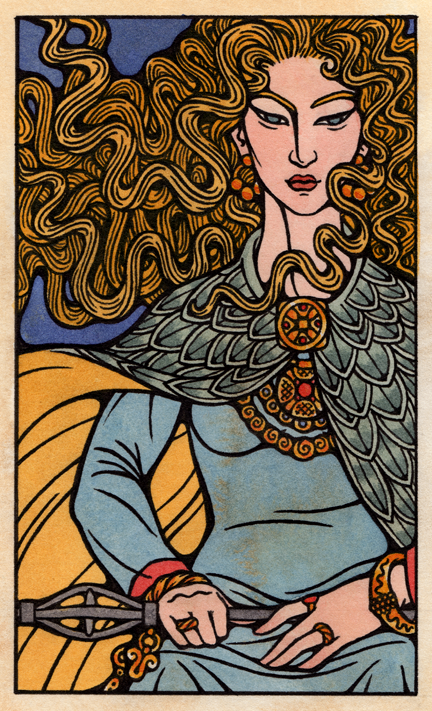
  Home of the World Goddess Oracle of Thalia Took, an unpublished deck of eighty-one cards of Goddesses from around the world, as well as other Deity and Tarot artwork. I now have a Patreon page! I've got all kinds of rewards set up starting at just $1 a month, including taking monthly suggestions on Goddesses to paint. Above, new art of Freyja, the Norse Goddess of beauty, love, and all that, Who was known for Her mastery of seiðr, a type of divination that could not only predict the future but influence it as well. Done as a commission! If you'd like your own, details are here. I've also made prints of my art available through ArtPal, if you're interested in one say for your altar; I've also recently gotten my art up on greeting cards at Zazzle. I've been doing a whole bunch of little Goddess art pieces lately, for example Amphitrite and Venus; I've been adding them on to the Goddess Art page as I go, so be sure to check in there regularly and see! On the World Goddess Oracle front, I recently redid Isis, as I was never quite happy with Her as I originally depicted Her. And I've been looking into self-publishing the deck, perhaps via Kickstarter or somesuch. On the left are also links to my series of God artwork, done in scratchboard, as well as to other Goddess art that is not a part of the World Goddess Oracle. I also have a bit of Tarot art and a series of Tarot spreads based off each Major Arcana, which prove useful sometimes. There is also my series of Dream Cards, for lack of a better title; I'm not sure quite what they are about, but I've found them quite resonant. And then there's the Obscure Goddess Online Directory, a series of articles about lesser-known Goddesses, starting with the Romans, and with a smattering of other cultures such as the Etruscans and Canaanites so far. I don't imagine I'll ever finish it, as it's a project for several lifetimes. |

|


