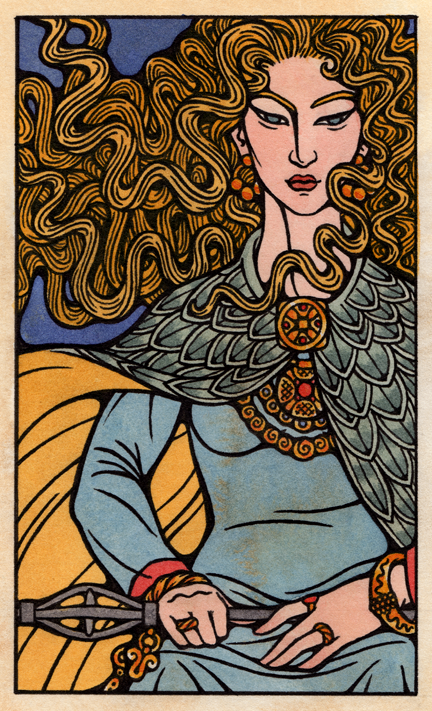

Fortuna Primigenia is an old Goddess of Fate and Luck in Roman
myth whose worship was centered around the city of Praeneste, the modern Palestrina
in Italy. Praeneste was a city of the Latini tribe in the region of Italy named
Latium for them, and was located about 20 miles south-east of Rome, on the coast
of the Tyrrhenian Sea. There Fortuna Primigenia had a great temple complex and
an oracle, appropriate to a Goddess of Fate.
Her name was often interpreted as "First-born" or "Eldest",
and taken to mean that She was the eldest daughter of Jupiter; so She was also
called puer Jouis, or "Child of Jupiter". However, the title
Primigenia should be more properly taken to mean "Primordial"
or "Original" Fortune, as it refers to the antiquity of Her worship
at Praeneste, which was older than that at Rome. As Praeneste was often at odds
with Rome during the Republic, and not made part of Rome until the first century
BCE, Fortuna Primigenia was regarded as a "foreign" Goddess by the
somewhat xenophobic Romans, though they did come to embrace Her in time.
As the "First-born" daughter of Jupiter, Fortuna Primigenia
was believed to fix the new-born child's destiny or fate. Her name could also
be interpreted as "First-bearer", as in the first to bear children;
and She was depicted as suckling two infant children, who were said to be Juno
and Jupiter, i.e., the supreme female and male principles, symbolizing totality
as Mother and Father Deities. Naturally as a Goddess connected with childbirth,
She was especially favored by married women.
Her temple complex in Praeneste was built into the side of a
great hill, and had several levels of terraces and staircases, a basilica, and
curia (meeting-hall), with the small circular temple to Fortuna at the top.
It was a huge complex, measuring 1300-plus feet at the base of it and stretching
vertically up the hillside for 450 feet, and it incorporated two reservoirs
which provided water for a great fountain as well as for the surrounding town.
The ruins today are very impressive, though a palace was built on the foundations
in the Renaissance; following the original layout, it kept the semicircular
shape of the colonnade just below the temple (alas, the temple itself has long
since vanished), as is not uncommon of medieval or Renaissance structures built
over ancient sites, since it's easier to built on foundations that are already
there than to take them apart and start from scratch. On the oldest level, that
of the basilica, are two small caves or grottoes, the one to the west most likely
being the original shrine of Fortuna around which the complex was built. The
temple of Fortuna Primigenia was one of the largest in ancient Italy, if not
the largest, and owing to its spectacular situation on a hill, could
be seen from all over Latium, even from as far away as Rome.
The Oracle of Fortuna at Praeneste was of a fame to rival Delphi's,
and was called the sortes Praenestinae, or "the Praenestine lots".
According to legend, one Numerius Suffustius was told in a dream to delve into
the stone at a certain spot in Praeneste. When he did just that, he found some
mysterious pieces of oak inscribed with sayings written in an archaic alphabet.
These tablets were then kept in a box and used at the oracle to Fortuna established
there: when the oracle was to be consulted, a young child went to the box and,
after shaking it, picked one of the tablets at random. He then gave it to the
questioner, who was left to interpret the meaning for him or herself. The Oracle
at Praeneste remained popular for centuries and was only closed down in the
reign of the Christian Emperor Theodosius in the 4th century CE.
Like Fors Fortuna, Fortuna Primigenia
had several temples in Rome. One of these was on the Capitoline Hill and was
traditionally ascribed to Servius Tullius, an early King of Rome who had been
born a slave and risen to be King, and who had also built a temple to Fors Fortuna
by the Tiber. Three more temples to Fortuna gave their name to a neighborhood
on the Quirinal Hill, the tres Fortunae, located just by the gate of
the porta Collina; one of these temples was dedicated to Fortuna
Publica, ("Fortuna of the People"), but the other two were to
Fortuna Primigenia. The largest of the three was given to Fortuna Publica Populi
Romani Quiritium Primigenia ("First-born Fortuna of the Roman Nation, its
People and Citizens"), Her name and titles as they were officially known
in Rome, and dedicated in 194 BCE on May 25th, which thereafter became its festival
day. The third temple, of which there is not much known, had its festival day
on November 13th.
Fortuna Primagenia's worship was originally centered in a grotto,
a small cave (it is related to the word crypt) of a type celebrated in
Italy for being a cool and refreshing place out of the sun; often water is found
in grottoes. Fortuna's Praenestine grotto likely did have a spring or other
form of water in it, and it had been decorated with a great mosaic in its floor
that depicted the Greek Sea-God Poseidon, who was equated with the Roman Neptune,
originally a God of fresh waters. Caves are a symbol of the earth and the Earth-Mother;
they are additionally gateways to the Underworld, and connect the lands of the
living and dead, the lands of mortals and the Gods. Oracles are frequently found
at sites that have caves or springs or that otherwise connect to the interior
of the earth through such features as natural fissures or volcanic vents (as
is the case at Delphi). Given this, Primordial Fortune can be seen as an ancient
chthonic Goddess, an Earth-Mother Who has the power to give abundant good things
from Her earthgold, silver, gems, plants, animals, a bountiful harvest,
success and good luckand Who can predict the future that She sets as a
Fate-Goddess Who controls the life, fortune, and death of all.
