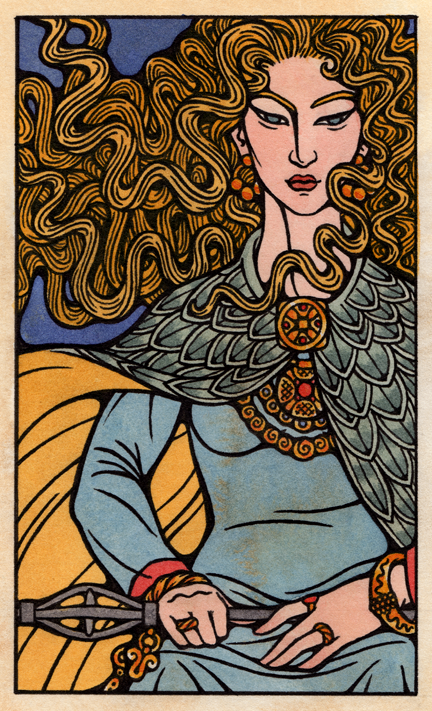

Juno Regina, or Juno the Queen, is Juno in Her aspect of Queen
of the Gods and Queen of Heaven. As Queen, She holds the sceptre and the patera
(a shallow dish for making ritual offerings) and wields the thunderbolt. She
is frequently shown wearing a royal diadem and a long veil; the magnificent
peacock is Her bird, and the aurata iuvenca, ("gilded heifer",
presumably a young cow whose horns have been gilt) is the animal considered
proper to offer in Her sacrifices. She protected the Roman people, and with
Her consort Jupiter and His daughter Minerva She headed the state cult. The
three of them made up the Capitoline Triad, whose worship can be traced back
to the Etruscan triad of Uni, Tinia and Menrfa.
These three were worshipped in the great joint temple on the Capitoline Hill
of Rome, usually called the temple of the Capitoline Triad or the temple of
Jupiter Optimus Maximus ("Bestest and Greatest Jupiter"), as His was
the central of the three cellae (temple chambers). This temple had very ancient
originstradition ascribes it to Tarquinius Priscus, an early King of Rome
said to have ruled in the late 6th century BCE and considered more legendary
than historic. Juno had Her cella to the left, Minerva to the right; and in
this temple were also two smaller shrines to the God Terminus and Goddess Iuventas,
who had been a part of a sanctuary to multiple Gods formerly on the site and
who refused to move! Each of the Triad had Her/His own hearth-altar, and though
it is not known for sure what the cult-statues of Juno and Minerva looked like,
they were probably of the same style and early date as Jupiter's, which was
of Etruscan workmanship and made in terracotta. Being on top of a hill this
temple was prone to being hit by lightning and burnt several times in various
fires, each time being rebuilt more magnificently than the last. It became customary
to store treasures dedicated to the state there, and in fact these treasures
had to be removed at least once to make more room, as they were clutterin' up
the place. It was considered the most majestic temple in Rome, with its gilded
roof-tiles, gold-plated doors and columns of white Pentelic marble shipped all
the way from Greece.
The ritual of removing a Deity from one sacred and dedicated
location is called evocation; this is the process that Terminus and Iuventas
refused to take part in. The Juno (or rather, Uni) of the Etruscan city of Veii
(Veia to the Etruscans) was according to tradition persuaded to abandon Her
besieged city after the Roman general/dictator Camillus vowed a splendid temple
to Her in Rome, and promised Her greater honors there. That, at any rate, is
the Roman version of things; and in 392 BCE the temple to Juno Regina on the
Aventine Hill was dedicated on September 1st. The xoanon (archaic wooden statue)
of Uni was brought to Her new home, and the Goddess received offerings there
primarily from women; later, during a time of national crisis, Juno was given
offerings that had formerly been made to other Gods. This Juno's Etruscan origins
changed the character of Juno Regina in Rome, and She became more of a protective
Deity who was regarded as a saviouress.
The Juno Regina of Veii may also be connected with the idea of
the Queen who represents the land, and whose approval is required before sovereignty
can be granted; and this may be part of why She was especially invoked for protection
during the Second Punic War, when the foreign general Hannibal invaded Italy.
During this war, which dragged on from 218-201 BCE, the matrons (married women)
of Rome organized and donated gifts to the temple of Juno Regina on the Aventine,
seeking protection on behalf of all the people. It was commonly believed at
this time that the Gods were angry with Rome, and the thinking could have been
that Juno Regina, as a Goddess of foreign origin from a conquered city, was
especially likely to be angry with Rome and so favor the Carthaginians in this
conflict as payback for Veii, or, that She could be easily wooed away from Rome
if the opportunity arose, as She had been from Veii.
Juno Regina had yet another temple in Rome, in the Circus Flaminius
(not properly a Roman circuswhat we'd call a horse trackbut
more a large square where triumphs were held). This temple was vowed by Lepidus
and built in 179 BCE, next to the temple of Jupiter Stator, with whom She was
associated. Her temple was considered a natural complement to Jupiter's, and
was the obvious choice of next in line to be built. It was connected to a temple
of Fortuna by a portico, and both Her temple and Jupiter's were home to many
famous works of art. A tale, dating to the restoration of both temples by Octavia
sometime during the reign of her brother Emperor Augustus, says that the workmen
got confused during the restoration and got the decorations and statues swapped
by accident. Whether or not that's true, it does indicate that the two
temples were of a similar size and importance, which further implies that the
two Deities were of an equal importance. The ruins of Juno Regina's temple in
the Circus Flaminius are still there, and three of the columns, standing in
their original positions, have been incorporated into the wall of a later building.
Juno Regina held a central place in Roman religion, as a representation
of the women of Rome; and She had powers of protection, like a mother or queen.
In the temple on the Capitoline, the three hearth-altars of Juno, Jupiter and
Minerva are also representative of their central role as a group; the hearth
is the symbol of the center, whether it's the hearth of the house, often used
as an altar in offerings to the Lares, or the hearth hosting the perpetual flame
in the Temple of Vesta in the Forum, representing
the heart of Rome.
