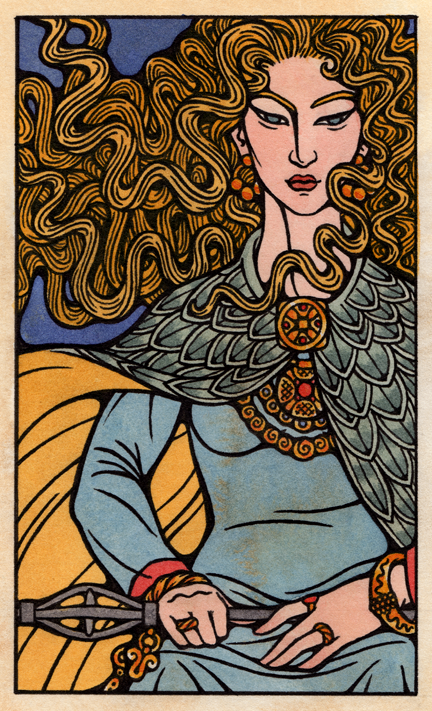

Rumina is a Roman Goddess of Breastfeeding and Women, Who causes
the milk to flow. Her name is related to an old Latin word for breast, rumis
or ruma, and translates to "the Nourisher", "She Who Breastfeeds"
or "Mother's Breast". Rumina was the protectress of all nursing young,
human and animal both.
She is a very ancient Goddess, and with Her consort or male counterpart
Rumino was said to protect milk-bearing cows and their calves. They are connected
with the Ficus Ruminalis, or "Suckling Fig", the sacred fig-tree at
the base of the Palatine Hill near to the River Tiber, where the abandoned infants
Romulus and Remus were said to have washed ashore. Under this tree the She-wolf
found them and let them nurse, saving their lives (and highlighting their divine
parentage) so they could grow up to found Rome. It was believed in ancient times
that the fig-tree got its name from the act of nursing and so was derived from
ruma, "breast", but it is now thought it shares a root with
the names Romulus and Roma (the city itself)maybe rumon, meaning
"river", perhaps an ancient name for the Tiber. (My guess is that
ruma and rumon are related anyway, as they both encompass ideas
of "flowing".)
Either way, Rumina had a shrine or sanctuary near to the Ficus
Ruminalis where She was appropriately given offerings of milk rather than the
usual wine. That area of the Palatine, the Cermalus (the name for part of the
western slope of the Palatine) was heavily associated with wolves and the Twins;
in this area was the Lupercal (Wolf) grotto, where the She-wolf hid when the
Twins were found. It was one of the most revered sites in ancient Rome, and
the cave was home to a spring. Its location has not yet been identified, though
it is traditionally said to have been near to where the clivus Victoriae (the
street which came down from the Palatine) and the vicus Tuscus (the road connecting
the Forum and the Circus Maximus) meet; but it may in fact have been located
in a different part of the Palatine. The Ficus Ruminalis was said to have been
the last remnant of the ancient sacred grove located there.
Rumina and Rumino were said to be represented by two fig trees
within a cave or grotto. The fig tree was associated with fertility, both male
and female, as the sap is milk-colored and may represent either milk or semen,
and the fruit has a great proportion of seeds. The fig-fruit itself is identified
with the breast due to its shape; and it is holy to Juno,
the great Roman Mother-Goddess, who is linked with Rumina. The fig is additionally
associated with goats, who were kept for their milk and are known for their
randy behavior, making them emblems of fertility also. Part of the festival
of the Lupercalia of February 15th, which began in the Lupercal grotto, involved
the sacrifice of a goat and the use of its skin in rites believed to help women
become pregnant.
Given all this, Rumina would seem to be not just a narrowly-defined
Goddess of breastfeeding Who protects the unweaned, but one Whose role was originally
that of a broader fertility Goddess Whose emblem is the fig-tree. Her association
with grottoes and springs (and perhaps rivers, if Her name was derived from
rumon rather than ruma) may have contributed to Her role as a
Goddess Who causes the life-giving milk to flow; and as the cave or grotto itself
is symbolic of the womb, from which the Waters of Life flow, perhaps Her association
with infants should include the roles of pregnancy and childbirth Goddess too.
At any rate, Rumina's powers of fertility, bounty and nourishment ensured that
the next generations of humans and animals would thrive.
Rumina is sister to the Goddesses Cuba
and Cunina, Who watch over children while they sleep;
She also hangs out with Educa and Potina,
Goddesses Who make sure children are well-nourished. Sometimes They are considered
attendants or aspects of Juno in Her role as Mother-Goddess.
Rumina as a fertility and fig-Goddess is quite similar to Juno
Caprotina, and one wonders (okay, I wonder) if the two share a common origin.
Also called: Diva Rumina ("the Goddess Rumina"), Rumilia,
Rumia
