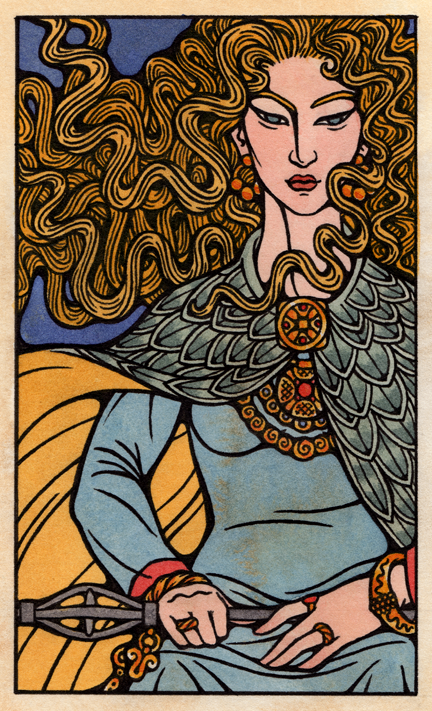

Thesan is the Etruscan Goddess of the Dawn, Divination and Childbirth,
as well as a Love-Goddess. She is depicted on several Etruscan mirror backs,
bearing, like many other Etruscan Goddesses, a great pair of wings from Her
back, especially appropriate to a Sky-Goddess. One meaning of Her name is simply
"Dawn", and related words are thesi, "illumination",
and thesviti, "clear or famous". The other meaning of Her name
connects Her with the ability to see the future, for thesan also means
"divination", as seen in the related Etruscan word thesanthei,
"divining" or "brilliant". This relates to Her function
as a Dawn Goddess--for as the dawn illuminates what was previously dark, so
divination throws light on the dark future and enables one to see what may happen.
She is called by some a childbirth Goddess, as She is present at the beginning
of the day, which finds its parallel in the beginning of a new baby's life.
Similarly, the Roman Goddess of Light and Childbirth, Lucina,
brings the infant into the light of the world.
The Etruscans identified their Thesan with the Greek Goddess
of the Dawn Eos. In the Greek legend, Aphrodite
had found Eos in bed with Her lover Ares; to punish Eos She "cursed"
Her with an insatiable taste for mortal youths, and Eos became infamous for
Her many lovers. The Etruscans seemed to quite like these stories and easily
transferred them to their Dawn-Goddess Thesan; the stories depicted on the mirrors
are generally straight out of Greek myth.
On one relief mirror back (kind of a rarity in Etruscan
mirrors since the decoration on the back is almost always engraved rather than
cast), Thesan is shown in the act of abducting Kephalos, a young man of Athens
who was married to the King's daughter, Procris. Thesan is winged here, and
wears a chiton and diagonal himation that flow in the breeze; about Her head
is a halo, to emphasize Her function as Light-Goddess. She runs off to the left
carrying Kephalos in Her arms, who is shown as nude and much smaller than She
is. He does not look at all distressed at the situation and He rests in Her
arms with his right hand on Her shoulder. Like many depictions of Etruscan women
and their lovers, She is shown as larger and therefore more important or powerful
than the man: this has been taken as an indication of the high status of Etruscan
women.
The same scene is depicted on a mirror handle in high relief
openwork; Kephalos is again quite a lot smaller (and younger) than Thesan, who
is not winged this time, but whose cloak billows behind Her in the breeze. She
smiles down at young Kephalos as She lifts him up, and he is nude save for a
short cloak and hunting boots.
Another favorite scene of Thesan/Eos depicts a far more somber
affair.When Her son Memnon (by Tithonus, another young man She abducted to be
Her lover) was killed in the Trojan War, Eos grieved so terribly that She threatened
never to bring forth the dawn again. She was finally persuaded to return, but
in Her grief She weeps tears of dew every morning for Her beloved son. One mirror-back
shows Her before Tinia (Zeus) with Thethis (Thetis), the mother of Achilles.
Both Goddesses plead with Tinia to spare their sons' lives; but both were already
doomed to die. The relief mirror mentioned above has been interpreted by some
as showing Thesan carrying off the body of Her dead son Memnon (who the Etruscans
called Memrun): the figures are not labelled as is usual in Etruscan mirrors,
making the differing interpretations possible.
Another more purely Etruscan depiction of Her shows Her with
Usil the Sun God and Nethuns (the Roman Neptune), God
of the Sea. It would appear that this mirror is to be symbolically read as the
dawn preceding the Sun at daybreak as it rises from the Sea (notwithstanding
the fact that Etruria is on the west coast of Italy).
Like more than a few Etruscan Goddesses, She seems to have survived
into Tuscan folklore at least until the 19th century as a spirit called Tesana.
She was said to visit mortals as they dreamt, in the time when the sun is rising
but before the sleeper had yet awakened. She was believed to bring words of
encouragement and comfort, and Her presence in a dream gave good fortune and
blessings for the day.
She is equated with Eos and Aurora,
the Roman Dawn-Goddess.
