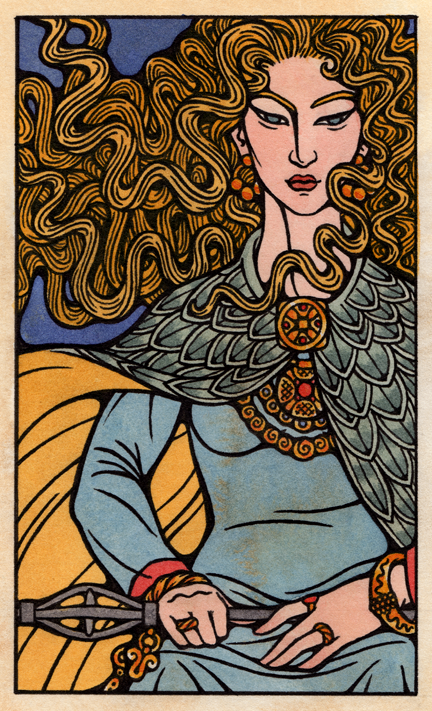

Turan is the Etruscan Goddess of Love and Beauty, much associated
with the Greek Aphrodite. She was the patron
Goddess of the city of Vulci, one of the main cities of Etruria, famous for
its cemeteries and rich grave goods that now supply many a museum's Roman collections.
Her name means "Lady" or "Mistress"; it is related to such
Etruscan words as turannuve, "lovable, venerable", tur
"give" or "dedicate", turan, "given" and
turza "offer", which bring together the ideas of love and worship,
implying that that which is lovable is also worthy of worship, and that love
and the sacred go together. Venus of the Romans shares
a similar idea in Her name, for it is related to the word venerate.
Turan is depicted on a great deal of Etruscan art: on mirror-backs
and terracotta panels, on vases and sculpture. Often She shares the iconography
and narrative details of Aphrodite, whom the Etruscans knew from contact with
Greek settlers in south and central Italy; She can be shown with doves or a
swanwhich in Etruscan style is given a name, Tusna, meaning "fullness"
or "lushness"or with the Etruscan version of one of Her lovers
such as Atuns (known as Attis or Adonis in Greek lands) or taking part in the
Judgement of Paris, the famous beauty-contest that ended up causing the Trojan
War. In the Judgement of Paris scenes She is shown with Uni
and Menrfa, and is easily identified by the fact that
of the three Goddesses, Turan is the one hiking up Her skirt to show off Her
trendy Etruscan boots and a good bit of leg.
In a more purely Etruscan style, Turan is often shown with various
attendants or handmaidens, including Lasa or the Lasae,
Goddesses of Fate. She presides over one scene on a mirror of the 4th century
BCE that depicts the bride Malaviskh being prepared
for Her wedding. The attendants Zipu, Hinthial
and Munthukh see to Malaviskh's makeup and hair
while Turan watches from the side; She holds a myrtle branch and wears rich
jewelry while a dove perches on Her shoulder and a swan or goose stands behind
Her. She seems to be overseeing the project, and is swathed in a concealing
cloak; this contributes to an older or more "matronly" appearance
than the other attending Goddesses, and perhaps this indicates an aspect of
Turan as a Goddess of Love within marriage. On another mirror She embraces Hercle
(Herakles) between Menrfa and a young male warrior.
She is again wearing rich jewelryan elaborate necklace, earrings, headband,
and several braceletsbut this time Her drapery has slipped and She is
mostly naked. On another, more elaborate, mirror She is again shown with Hercle,
who holds an Erote or winged Cupid-figure; to their right are Tinia and Thalna,
who form a couple, and it is reasonable to conclude that Turan and Hercle do
as well. She holds a staff tipped with what looks to be a pomegranate; this
could be indicative of Her aspect as a fertility Goddess. The pairing of Aphrodite
with Herakles is not known in Greek legend, and no Etruscan tales of them have
come down to us, but evidently They were lovers.
She shared a temple with Menrfa and probably another Deity, likely
Artimi (Artemis) or Aplu (Apollo) at the Etruscan city of Veii, the famous Temple
Portonaccio, which had three cellae or chambers much like the later Roman temple
of the Capitoline triad (Juno, Minerva, and Jupiter). She also had a cult center
at Gravisca (the modern Torre di Corneto), the port town of Tarquinia in Latium
where many Greeks came to trade, and where a large sanctuary dedicated to Turan
was found with the remains of many votive objects inscribed to Her. Two of the
other buildings there were dedicated to Hera and Demeter, as per the Greek influence.
Again, Turan is one of the more than a few Etruscan Goddesses
who seems to have survived into Tuscan folklore. Called Turanna, She is a spirit
or faery of beauty and happiness, who helps lovers and those in love.
She is also called Tiphanati.
