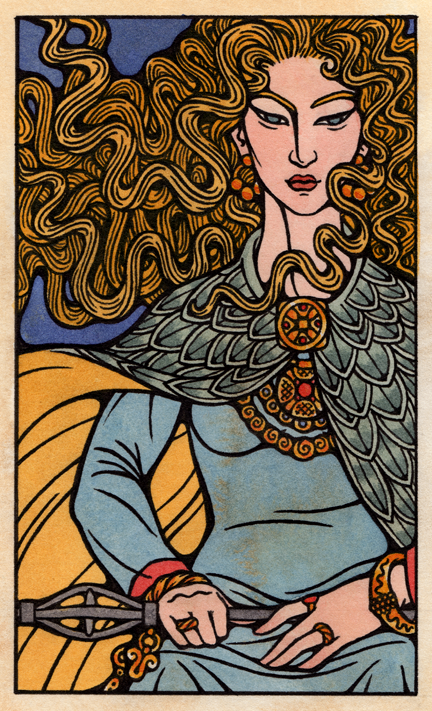

Uni is the Great Goddess of the Etruscans, who has facets of
a Mother-Goddess, Birth-Goddess, Star-Goddess, and Love-Goddess, and who is
the forerunner or parallel of the Roman Juno. She was worshipped from very ancient
times by the tribes of the Sabines, Umbrians, and Latins of central Italy and
the Oscans of south-central Italy, as well as by the Etruscans. She is usually
said to be the wife of Tinia, as Juno was of Jupiter, and Hera of Zeus, but
in some cases it seems Thalna was Tinia's wife. Uni
was the pre-eminent Goddess of the Etruscan pantheon and was one of a select
number of Etruscan Deities with the power to hurl thunderbolts. She watched
over and protected women, and all cities were under Her care, most especially
the cities of Perugia (Latin Perusia), and Pyrgi, the port-town of Cisra (the
Latin Caere, modern Cerveteri). She was considered the mother of Hercle (the
Etruscanized Heracles), unlike the Greek myth, where Heracles is the son of
Alcmene by Zeus. She forms a triad with Menrfa and
Tinia that lasted into Roman times as the Capitoline triad of Juno, Minerva
and Jupiter.
It is not known if the Etruscan name "Uni" or the Latin
name "Juno" came first, for while they do seem to be related, there
is not enough evidence for a definitive answer: "Juno" may be derived
from "Uni", or "Uni" from "Juno". If "Juno"
was first, and the Etruscans borrowed the name of the Latin Goddess as a name
for the Greek Hera, then the name is most likely connected to a root meaning
"young", probably in reference to Her role as Birth-Goddess. If the
Etruscan name was first, then Uni's name means "She Who Gives", and
likely refers both to Her position as a kindly Mother-Goddess as well as one
who receives and grants the prayers of Her followers. Related words in Etruscan
would then be una "benevolence", une "reward"
or "thanks", unxva, "favor", un "to grant",
and unata "favorite", as well as uneitha, "satisfaction"
or "pleasure", which may have helped to connect Her with the Phoenician
Goddess Astarte, who is a Love-Goddess. The worship of Juno in Rome was traditionally
said to have been brought there from the great Etruscan city of Veia (Latin
Veii), about 11 miles northwest of Rome, so my guess is that the Latin derives
from the Etruscan and Uni is first.
Uni had two sanctuaries in Pyrgi (the Latin name of the city),
the port of the city of Cisra or Chaisra: the older one dates to the 6th century
BCE, the newer one to the 5th century, and both are dedicated to Her as Uni-Astarte.
Uni had been equated with the Phoenician Goddess Astarte by the Etruscans, probably
due to the proximity of the Phoenician outpost of Carthage. Pyrgi was famed
for its wealth in ancient times, and the shrine of Uni there was said to be
very richly furnished. Classical writers referred to Her temple at Pyrgi as
belonging to Ilithiya or Lucina, Greek and Roman names, respectively, of Birth-Goddesses,
suggesting that Uni's cult in Pyrgi was especially focussed on Her aspect as
Mother and Childbirth Goddess; however this must have been only one of Her facets
worshipped there, as the connection with Astarte gave Her a decidedly celestial
slant. Three gold sheets have been found there with inscriptions to Uni-Astarte
describing the dedication of the temple and of a statue to Her (coincidentally
in the month of Khurvar or June, the month the Romans named for Juno). This
emphasis on Her aspect as Star-Goddess likely came about by finding the commonalities
between the Sky-Goddess Uni and the Goddess of the planet Venus Astarte; Dea
Caelestis, a late Roman name for the Carthaginian Goddess Tanit, may reflect
a similar identification.
Uni was the patron Goddess of Perusia, which was one of the main
cities of Etruria, and one of the twelve cities of the Etruscan Federation.
She had a temple there; after Octavian, the future Emperor Augustus beseiged
the place and Perusia was almost entirely destroyed by a terrible fire, only
the temples of Uni and Sethlans (the Etruscan Vulcan) survived. After the fire,
however, it is said that Uni was replaced by Sethlans as the patron deity: perhaps
this was out of fear of another fire, or as a belated appeasement to Sethlans;
for as the Fire-God, He was believed to be able to prevent fires if propitiated.
Uni has a house on the Piacenza liver, a bronze model of a sheep's
liver used for teaching diviners which is divided into symbolic "houses"
representing areas of the sky or cosmos. Her house is located in the northeast
of the sky, in the 2nd house, just after Tinia (the Etruscan equivalent to Jupiter),
in the region of the summa felicitas, or "greatest good fortune".
Uni was assimilated to the Greek Hera from an early time and
many depictions of Uni in Etruscan art show Her in Hera's role in scenes from
the Greek myths, such as being freed by Hephaestos/Sethlans from a trick throne
He had made to punish Her. However on one Etruscan mirror She is depicted nursing
Hercle as a full-grown man; this is very much at odds with the Greek interpretation
of this myth, which states that Hera had to be tricked into suckling the infant
Herakles (symbolically indicating Her acceptance of Him, or a transfer or giving
of power through Her breast milk). I have always been suspicious of the antagonism
between Hera and Herakles; for though in the Greek legend His name (which means
"Glory of Hera") is given to him as a means of appeasing Hera's jealousy
(for Zeus had fathered him by another woman), my hunch is that the true, older
tale is one in which Herakles is genuinely Hera's son. It would seem that the
Etruscans had the same hunch (or access to an earlier, lost, Greek myth), for
they name their Hercle as Uni's son.
Alternate spellings: Unei
Also called: Uni Mae or Mae Uni. It is not sure what "Mae"
means, but it could be related to the Goddess Maia
Maiestas, Maia the Majestic, a Roman Goddess of the warming earth of Springtime
Who gives Her name to the month of May. If so, the epithet "Mae" would
mean "large", "great" or "powerful", and refer
to Uni's role as the principal Goddess in the Etruscan pantheon. Cupra
is Her name among the Picene, Sabine, and Umbrian tribes of central Italy.
