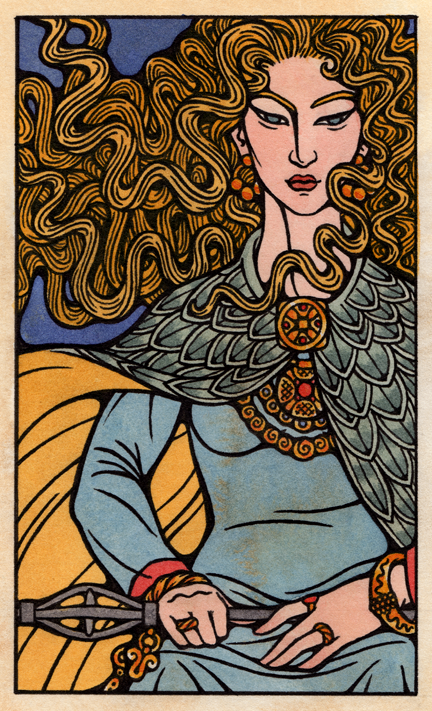

Vanth is an Etruscan Goddess of the Underworld, perhaps a psychopomp,
whose presence indicates recent or impending death. Her character is a little
ambigious--for while She is present at these scenes She does not usually take
an active role, and thus some authorities call Her an "angel", others
a "demon" (which is, ultimately, neither here nor there as those designations
are outside of the original religion). Aside from the occasional statue or other
independent representation, Vanth is nearly always depicted in scenes with an
Underworld or death-themefunerary monuments are an especially popular
setting for Herand Her part appears to be mostly one of observation.
Quite a few Etruscan Goddesses were intermittently shown with
wings, but with Vanth they seem to be an integral part of Her character: She
is almost always shown with great arching wings that spread out behind Her and
which have probably contributed to the appellation of "angel". Sometimes
Her wings are painted with eyes, perhaps to represent all-seeing and inevitable
death. With many of the other Goddesses (and the rare male Deity or exalted
human such as Khalkas the Seer, a haruspex depicted on a mirror-back) the wings
seem to be a simple indication of divinity (or in the case of mortals divine
inspiration) as they are not always present; with Vanth, the fact that She is
nearly always winged seems to point to Her great importance among the Gods,
or perhaps indicates that She is a more purely Etruscan idea of Divinity, who
unlike many other Etrsucan Goddesses, had no real Greek equivalent. A similar
situation occurs with Lasa, a Fate-Goddess who was not
strongly equated with any Greek Goddess; like Vanth, Her wings are an important
and especial part of Her attributes.
Another part of Vanth's particular iconography is Her outfit:
peculiarly Her own, it consists of a short gathered or pleated skirt that is
doubly belted (once underneath and then again over the folded-down part), short
hunting boots, and nothing above the waist save a band or baldric that crosses
between Her breasts. This outfit gives Vanth a distinctive active appearance,
much like Artemis in Her short chiton that She wore for ease in running. Vanth
sometimes carries a sword, though She rarely uses it; more often She carries
a torch with which to light the dark Underworld. She can also be shown with
a key with which to open the tomb or gate to the Underworld; and/or with snakes
twined around both forearms, their heads in Her hands.
She is quite frequently depicted as a partner to Kharun, the
Etruscan version of the Greek Charon, the Underworld guardian whose job it was
to ferry souls over the River Styx. One favorite way of pairing them was to
paint one on each side of the door of a tomb as if guarding the entrance. She
has been called the "servant" of Charon; however, of all the Etruscan
Death- or Underworld-Deities (including Kharun) Vanth has the most representations
in Etruscan art, which leads me, anyway, to conclude that they were at least
equals, and that more probably Vanth was Kharuns' boss.
Despite Vanth's presence in some gruesome scenesof battles
or prisoner sacrificesShe seems to have had a distant, if not benevolent,
role in things: though a harbinger of death, She does not appear to cause it.
Her torch points to a possible role as a psychopomp, a God or other being
who guides or escorts the newly-dead on the dark paths to the Underworld; perhaps,
then She calmy waits near battles or other scenes of death so that She may fulfill
this function. She does appear, at least in one depiction, to have some influence
in saving someone from death: on the pediment of the temple at Tlamu
(Latin Telamon, modern Talamone), She is shown riding in a chariot with Adrastus,
the only Hero of the Seven Against Thebes who made it home alive. Though the
sculpture itself is fragmentary, Vanth is shown in Her unmistakable outfit of
crossed baldrics between bare breasts, with Her wings outstretched behind Her.
She has Her arms about Adrastus protectively as he makes his escape.
Vanth seems to have appeared among the Etruscans in the 4th century
BCE, as Her earliest depictions only trace that far back, but She does not appear
to have been imported from the Greeks, though She has been loosely linked to
the Greek idea of the Erinyes (called in Rome the Furies), who were winged Goddesses
of Vengeance. Once on the scene however She proved quite popular; and Her worship
made it as far as Campania, where a bronze statuette of Her from 425-400BCE
was found not far from Mt Vesuvius. Remembrance of Vanth may have persisted
even into Roman times: in the Villa of the Mysteries at Pompeii is a famous
fresco of the 1st century CE depicting some sort of Dionysian initiation ritual.
One of the participants is a winged woman with a switch; she wears boots and
a short skirt and has been identified as Vanth. Though the significance and
exact order of this initiation scene is still a matter of debate, the presence
of Vanth or a Vanth-like figure may relate to Her old function as a Death-Goddess
or Psychopomp: for initiation is symbolically seen as dying to one's old way
of life to be reborn into the new.
Like the Lasae, the Vanths are sometimes spoken of in the plural,
and make up a loose band of Underworld Goddesses or Spirits.
Also called: Van
